

Machine Learning Downscaling Capability for Environmental Forecasts
|
P.F.J. Lermusiaux, A.N. Suresh Babu, A. Sadam, P.J. Haley, Jr., C. Mirabito Massachusetts Institute of Technology
|
Drs. E. Coelho, K. Verlinden Applied Ocean Sciences |
Project Summary Ongoing MIT-MSEAS Research Additional Links MSEAS Project-supported Publications Background Information
|
|
| This research is sponsored by Applied Ocean Sciences. | |||

Project Summary
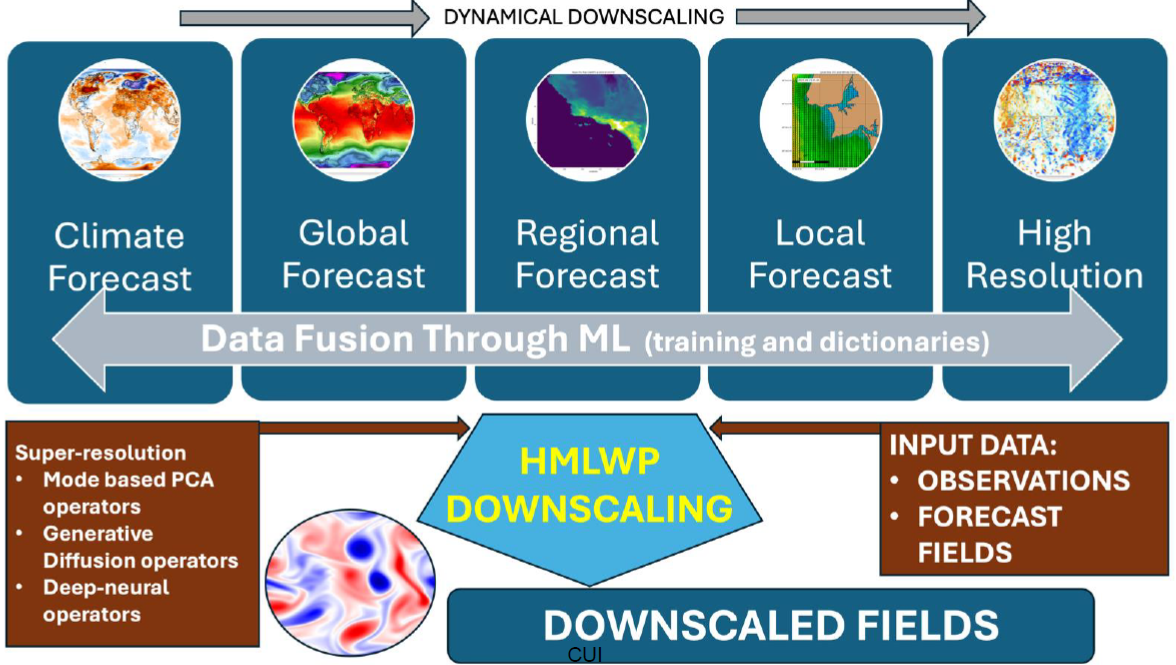
The objective of this SBIR on “Machine Learning Downscaling Capability for Environmental Forecasts” is to develop a capability to generate skillful, near real-time environmental forecasts (of the atmosphere, ocean, sea ice, and/or ionosphere) at a much higher spatial horizontal resolution (less than 1 km) and vertical resolution (on the order of 10 m, particularly in the atmospheric boundary layer and/or upper ocean) than current machine learning weather prediction (MLWP) techniques using downscaling or similar methodologies for tactical/local scale applications.
Background information is available below.
| Top of page |  |
Ongoing MIT-MSEAS Research
For the Phase I periods, we plan to further compare existing methods and begin developing new neural operators, multiscale physics-informed vision transformers (ViTs), generative diffusion models, and graph neural networks (GNNs) for MLWP downscaling to high-resolution fields. Specifically, we will start to:
- Derive, implement, and test new downscaling ML architectures for conservative dynamical systems and interpretable and generalized delay neural closure models (nCMs).
- Utilize information theory to characterize the performance of ML models and obtain better training data and data collection schemes.
- Further develop and test new neural data assimilation (nDA) and generative diffusion schemes for idealized super-resolution, uncertainty quantification, and data assimilation in latent and reduced spaces. We expect that the training and application of our generative diffusion models for super-resolution downscaling will constitute the dominant part of our contribution during this Phase I effort. For test cases, we will employ quasi-geostrophic turbulence flows and other highly nonlinear weather dynamics. We will build upon our neural multiscale latent space representation and stochastic Dynamically Orthogonal Gaussian-Mixture-Model Bayesian data assimilation.
- Implement differentiable software for more realistic multi-dynamics, multi-resolution, and super-accurate Lagrangian advection schemes, enabling fast ML training and software integration on GPUs.
- Use comprehensive skill metrics and continue to develop robust methods for training, validation, and verification of our MLWP downscaling to high-resolution environmental fields.
Publications
MSEAS Project-supported Publications
| Top of page | |
Additional Links
| Top of page | |
Background Information
While rapid and impressive progress in the development of skillful MLWP and related environmental models over the past several years has been promising for improving near real-time forecasting, missing technological capability requirements must be solved before such tools can be used operationally. Among the biggest gaps in MLWP - as well as in operational numerical weather prediction (NWP) and even climate simulations - is the disconnect between the improved predictability from large/global scale physics and observations and the lack of forecast fidelity at the local/tactical scale (less than 1 km resolution in the horizontal and high-fidelity in the vertical). Some progress can be made rapidly through the use of ML methods ameliorating the intensive computing requirements, but other progress is needed in scientific methodology to attain higher resolution forecast from lower resolution models informed by and/or consistent with physics-based principles and/or models (see references). This SBIR topic seeks to leverage advances in ML methods, environmental prediction, and downscaling/super resolution techniques to develop new capabilities for targeted local and tactical scale short-range to medium-range forecasts. Many uses of environmental predictions (e.g., tropical cyclone wind and surge effects, electro-optical or acoustic propagation in the boundary layer, coastal winds, terrain-induced phenomena, aviation visibility, ice-edge circulations, ocean eddies, navigation through sea ice) require knowledge of small-scale features to properly calibrate the effects of a forecast. Efforts will synthesize various methodologies to take a coarse set of environmental prediction information and utilize additional data, ML methods, and modeling techniques to better inform predictions of tactical/local scale effects. A particular emphasis on validating realistic environmental structures, particularly given the lack of observational data at these scales, will be necessary.
| Top of page | |

