headgraphic
loader graphic

Loading content ...

Anantha Receives Ocean Engineering Travel Award

We are pleased to announce that Anantha Babu has awarded the Travel Award in Ocean Engineering. All of the submissions for this noteworthy academic honor were strong, and they found his application to be of particular merit. Congratulations Anantha! 

Yet Another MSEAS Pizza Party!

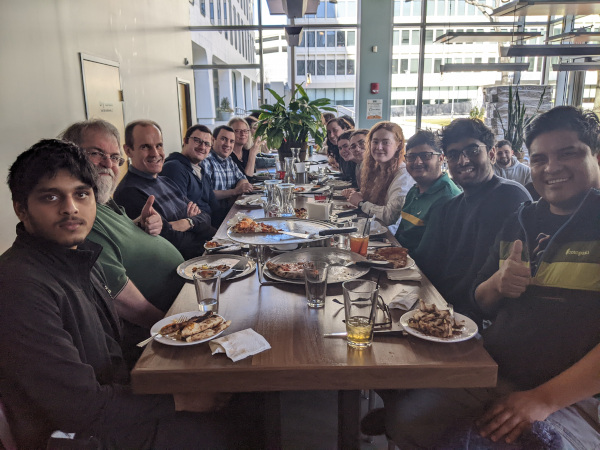
In February 2025, we had a group lunch at Area Four to celebrated Sioban’s completion of her MSEAS visit, and to mark the start of the spring semester. Sanaa showed us how to be in two places at once!

Francesco Benfenati


I am currently a PhD student in the Physics and Astronomy Department, at the University of Bologna (Italy). I will be joining the MSEAS group from January to April 2025, for a visiting period. My research interest is related to ocean submesoscale and marine litter transport, with focus on oil spill modelling. I really enjoy developing softwares for research purposes. As regards my private life, I enjoy cooking, trekking and practicing sports. I love music and playing the double bass. I am married with one daughter.

Alternating-Implicit Dynamically Orthogonal Runge-Kutta Schemes and Efficient Nonlinearity Evaluation

We introduce a family of implicit integration methods for the dynamical low-rank approximation: the alternating-implicit dynamically orthogonal Runge-Kutta (ai-DORK) schemes. Explicit integration often requires restrictively small time steps and has stability issues; our implicit schemes eliminate these concerns in the low-rank setting. We incorporate our alternating iterative low-rank linear solver into high-order Runge-Kutta methods, creating accurate and stable schemes for a variety of previously intractable problems including stiff systems. Fully implicit and implicit-explicit (IMEX) ai-DORK are derived, and we perform a stability analysis on both. The schemes may be made rank-adaptative and can handle ill-conditioned systems. To evaluate nonlinearities effectively, we propose a local/piecewise polynomial approximation with adaptive clustering, and on-the-fly reclustering may be performed efficiently in the coefficient space. We demonstrate the ai-DORK schemes and our local nonlinear approximation technique on an ill-conditioned matrix differential equation, a stiff, two-dimensional viscous Burgers’ equation, the nonlinear, stochastic ray equations, the nonlinear, stochastic Hamilton-Jacobi-Bellman PDE for time-optimal path planning, and the parabolic wave equation with low-rank domain decomposition in Massachusetts Bay.

An Adaptive High-Order Locally-Nonhydrostatic Ocean Solver

To simulate and study ocean phenomena involving complex dynamics over a wider range of scales, from regional to small scales (e.g., thousands of kilometers to meters), resolving submesoscale features, nonlinear internal waves, subduction, and overturning where they occur, non-hydrostatic (NHS) ocean models are needed, at least locally. The main computational burden for NHS models arises from solving a globally coupled 3D elliptic PDE for the NHS pressure. To address this challenge, we start with a high-order hybridizable discontinuous Galerkin (HDG) (Nguyen et al. 2009) finite element NHS ocean solver (Ueckermann and Lermusiaux 2016) that is well suited for multidynamics systems. We present a new adaptive algorithm to decompose a domain into NHS and HS dynamics subdomains and solve their corresponding equations, thereby reducing the cost associated with the NHS pressure solution step. The NHS/HS subdomains are adapted based on new numerical NHS estimators, such that NHS dynamics is used only where needed. We compare and explore choices of boundary conditions imposed on the internal boundaries between subdomains of different dynamics. We evaluate and analyze the computational costs and accuracy of the adaptive NHS-HS solver using three idealized NHS dynamics test cases, (i) idealized internal waves (Vitousek and Fringer 2011), (ii)  tidally-forced oscillatory flow over seamounts and (iii)  bottom gravity currents. We then complete more realistic NHS-HS simulations of Rayleigh-Taylor instability-driven subduction events by nesting with our MSEAS realistic and operational data-assimilative HS ocean modeling system. Finally, we discuss DG-FEM-based numerical techniques to stabilize and accelerate the high-order ocean solvers by leveraging the high aspect ratio characteristic of ocean domains.