

Loading content ...
MSEAS Presents Papers at Oceans 24 Halifax
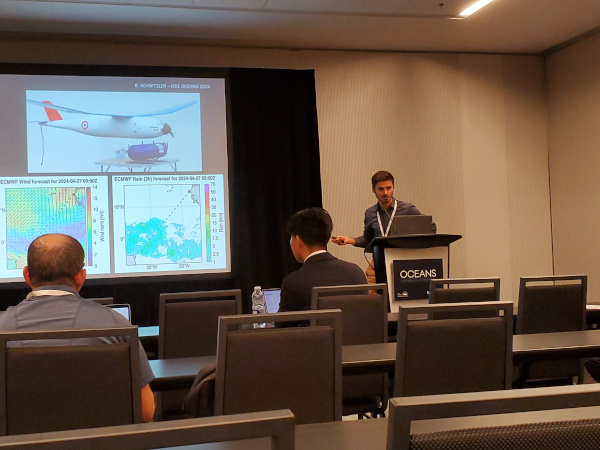
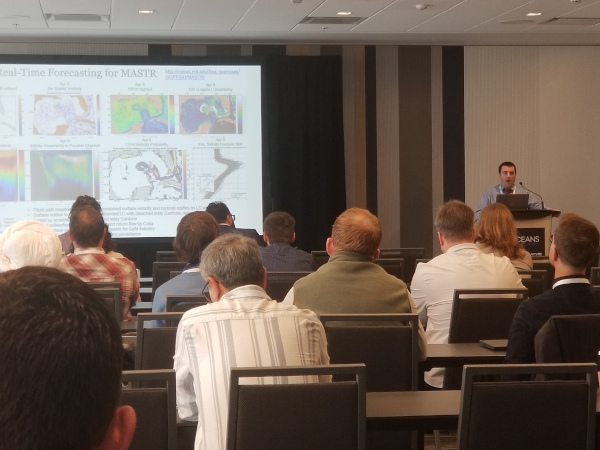
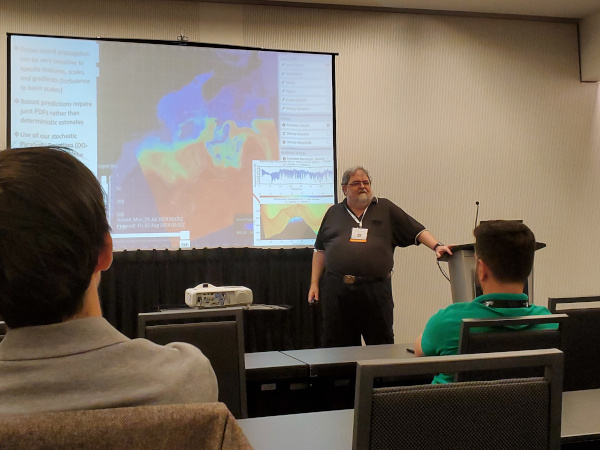
Bastien, Chris, Ellen, and Pat all presented the IEEE Oceans 2024 papers this past week at the IEEE Oceans 24 Conference in Halifax, Nova Scotia. Check out some pictures of all of them in action…
Congratulations to Bastien, Chris, Ellen, and Pat!
MSEAS Research Named Part of 2024 “Oscars of Innovation”
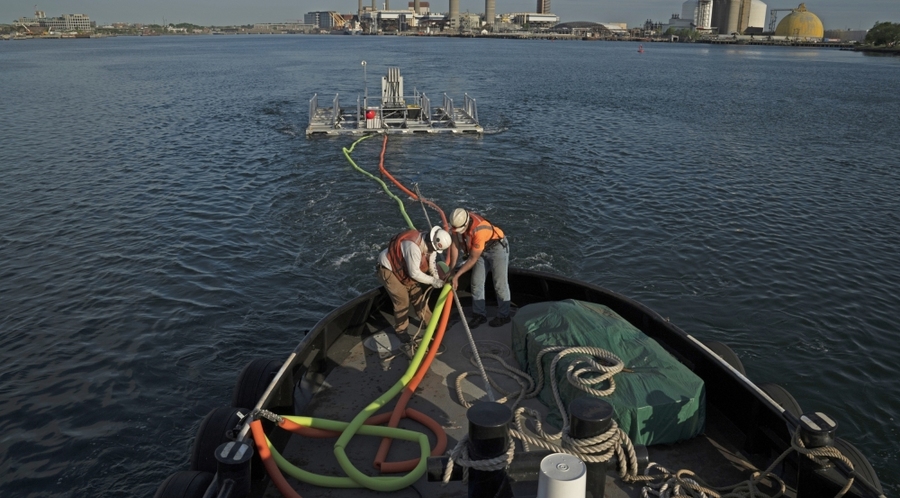
Two of the fifteen Lincoln Laboratory technologies recognized by 2024 R&D 100 Awards, sometimes called the “Oscars of Innovation,” are MechE Collaborations. One of these, “Autonomous sparse-aperture multibeam echo sounder technology,” is by MSEAS as part of the Wide Area Ocean Floor Mapping project, sponsored by MIT Lincoln Lab.
More information can be found in http://mseas.mit.edu/?p=6794
Congrats again to Aaron, Wael, Pat, and Chris!
Hazard-Time Optimal Path Planning for Collaborative Air and Sea Drones
General differential equations for multi-objective reachability and optimal planning are used to guide autonomous air and sea drones in hazard-time optimal missions. The vehicles minimize exposure to hazards and travel time, leveraging the dynamic environments with strong flows and steering clear of dynamic hazardous regions. We demonstrate the approach first with an autonomous air drone that crosses the Atlantic Ocean optimizing travel time using trade winds while avoiding hazardous rain storms in the inter-tropical convergence zone. We then consider an air drone that exploits winds and avoids hazardous rains to transport an ocean vehicle to a target destination. The ocean vehicle then completes its own hazard-time optimal mission, leveraging ocean currents and avoiding vessel traffic hazards. In all cases, we predict hazard-time reachable sets, Pareto fronts, and optimal paths. The results highlight the benefits of considering hazards in optimal path planning.
Real-time Probabilistic Reachability Forecasting for Gliders in the Gulf of Mexico
As part of the Mini-Adaptive Sampling Test Run (MASTR) experiment in the Gulf of Mexico (GoM) region from February to April 2024, we demonstrated real-time deterministic and probabilistic reachability analysis and time-optimal path planning to guide a fleet of four ocean gliders. The governing differential equations for reachability analysis and time-optimal path planning were numerically integrated in real-time and forced by currents from our large-ensemble ocean forecasts. We illustrate the real-time deterministic and probabilistic forward reachability analyses, reachability and path planning for glider pickups, time-optimal path planning for gliders in distress, and planning of future glider deployments. Results show that the actual paths of gliders were contained within our reachable set forecasts and in accord with the dynamic reachability fronts. Our time-optimal headings and paths also predicted real glider motions, even for longer-range predictions of weeks to a month duration. Reachability and time-optimal path planning forecasts were successfully employed for glider recovery. They also enabled exploring options for future glider deployments.

