Abstract: We begin with a motivation for the challenges faced in weather and climate modeling and then describe why we need special time-integration methods in order to evolve the governing equations forward in time. A quick review of element-based Galerkin (EBG) methods that we use in our models will be given followed by a description of the contravariant form of the discretization that then simplifies the application of horizontally explicit vertically implicit (HEVI) time-integrators regardless of whether we are solving regional or global models. This talk is motivated by my group and collaborators’ research in building operational weather prediction models as well as advancing the field for application in climate, space weather, and ocean dynamics. A list of publications on these topics can be found at: https://frankgiraldo.wixsite.com/mysite/publications
Biography: Francis Giraldo is a distinguished professor in the Department of Applied Mathematics at the Naval Postgraduate School in Monterey, California. He is in the Scientific Computing group and mostly teaches and performs research in this area. For example, he teaches Numerical Linear Algebra, Numerical Analysis, Galerkin Methods, and Scientific Computing. He is also an Adjunct Professor of Applied Mathematics at the University of California at Santa Cruz. His research area is in numerical methods for partial differential equations (PDEs). Although he mainly works on nonlinear systems of hyperbolic equations, he also works on elliptic and parabolic PDEs.


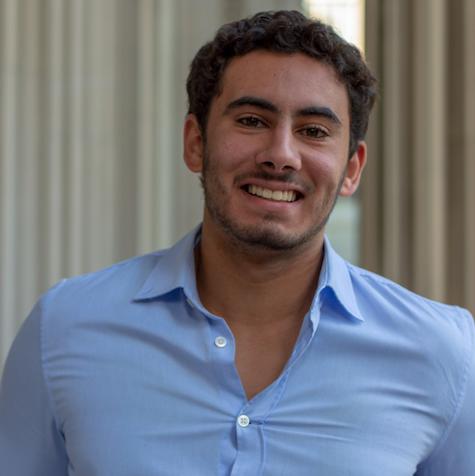


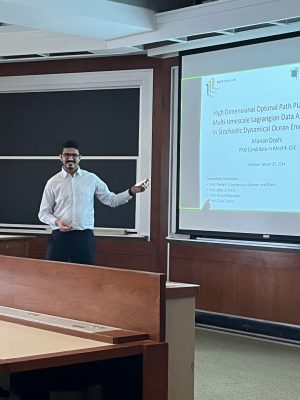 Congratulations to Dr. Manan Doshi on his graduation! Manan successfully defended and received his PhD from Mechanical Engineering for his research on “High Dimensional Optimal Path Planning and Generalized Lagrangian Data Assimilation in Stochastic Dynamical Ocean Environments” with our MSEAS group at MIT. We wish all the best to Manan on plotting his future path!

