
headgraphic
loader graphic

Loading content ...

Harmonizing the Virtual Classroom: A Musical Tribute to Class 2.29

In the spring semester of 2021, amidst the upheaval of remote education, the members of class 2.29 “Numerical Fluid Mechanics” navigated the challenges of online learning with grace and resilience. Led by their dedicated Professor Pierre Lermusiaux, supported by TA’s Aaron Charous and Corbin Foucart and administrative assistant Lisa Maxwell, the class embraced virtual tools to foster engagement and collaboration. Throughout the semester, they engaged actively in discussions and presentations using digital platforms. Despite the challenges of distance, the class maintained a sense of camaraderie and enthusiasm. During the final project presentations, Lisa’s ukulele performance added a memorable touch. Singing the lyrics she penned, Lisa’s song served as a heartfelt reminder of their shared journey through remote learning.
The 2.29 Song
Oh yeah we're 2.29
We had our whole class online
In the Spring of '21
Pierre taught twice a week
In a Zoom room he would speak
Can't believe the semester's gone!

Pierre buzzed like a bee
to keep us awake...THAT'S SO MIT!
Where were you at 11:35...?
Crank Nicholson's a finite
Dynamics you're dynamite
It's pahDAY (not PAHday)
you need to derive!

There were equations Euler
(that's quasilinear!),
Taylor Tables and fluid flow...
The first derivative? Give me a sedative!
Let me say (implicitly and explicitly)
where you can go!

That's right we're 2.29!
We had class all online
in the Spring of '21.
We learned lots and lots,
now we're dynamics Hot Shots!
Thanks for being so much fun!
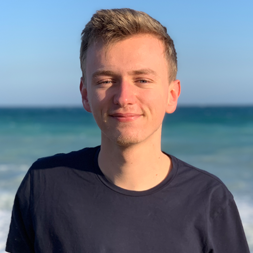

Marcoul Robin

Marcoul is a graduate student in Science and Executive Engineering at École des Mines in Paris, France. Marcoul joined MSEAS in March 2024 as a visiting student. His research interests include Bayesian learning, machine learning and data assimilation for ocean acoustics. He has spent most of his life near the coastal city of Nice, France. Prior to joining MIT, he received his Bachelor’s degree with Honours in Mathematics and Physics from PSL University in Paris. Apart from academia he loves hiking, biking and traveling.

Bastien Schnitzler

Bastien is a PhD student at ISAE-SUPAERO and ENAC in Toulouse, France. He joined MSEAS in March 2024 as a Visiting Student. Bastien is working on trajectory optimization for both airborne drones in wind fields and underwater drones in sea currents. Prior to the PhD, Bastien graduated with a Master of Science in the Design of Intelligent Autonomous Systems from Ecole Polytechnique, Paris, with joint degrees at ISAE-SUPAERO in Aircraft Design and Toulouse University in Operations Research. His research interests are focused on optimal control for airborne platforms as well as aircraft design optimization. Apart from research, he enjoys running, hiking in the Pyrenees and playing tennis.

Trajectory Optimization in Unsteady Flow Fields: The Extremal Approach

Speaker: Bastien Schnitzler
[Announcement (PDF)]

Speaker Affiliation: PhD Candidate, Ecole Nationale de l'Aviation Civile (ENAC), Toulouse, France
Date: Friday, March 8, 2024 at 2 p.m., in 5-314

Adaptive Nonhydrostatic-Hydrostatic Hybridizable Discontinuous Galerkin Ocean Solver

Numerical modeling of ocean physics is essential for multiple applications. However, the large range of scales and interactions involved in ocean dynamics make numerical modeling challenging and expensive. Many regional ocean models resort to a hydrostatic (HS) approximation that reduces the computational burden. However, a challenge is to capture and study ocean phenomena involving complex dynamics over a wider range of scales and processes, from regional to small scales (e.g., thousands of kilometers to meters), resolving submesocales, nonlinear internal waves, subduction, and overturning where they occur. Many such local dynamics require non-hydrostatic (NHS) ocean models. The main computational cost for NHS models arises from solving a globally coupled elliptic PDE for the NHS pressure. Our main research thrust is to optimally reduce these costs so that the NHS dynamics are resolved where needed.

We start from a high-order hybridizable discontinuous Galerkin (HDG) finite element NHS ocean solver, which is well suited for multidynamics systems. We present a new adaptive algorithm to decompose a domain into NHS and HS dynamics subdomains and solve their corresponding equations, thereby reducing the cost associated with the NHS pressure solution step. The NHS/HS subdomains are adapted based on new numerical NHS estimators, such that NHS dynamics is used only where needed. Since the choice of boundary condition imposed on the internal boundaries between subdomains is crucial to maintain accuracy, we explore and compare different choices. To evaluate the computational costs and accuracy of the adaptive NHS-HS solver, we first complete several analyses using internal solitary waves (e.g. Vitousek and Fringer 2011). We then complete more realistic NHS-HS simulations of Rayleigh-Taylor instability-driven subduction events by nesting with our MSEAS realistic and operational data-assimilative HS ocean modeling system.