headgraphic
loader graphic

Loading content ...

Towards Scalable Modern Marine Ecosystem Monitoring

Speaker: Loïcka Baille
[Announcement (PDF)]

Speaker Affiliation: PhD Candidate, MIT-WHOI Joint Program, Woods Hole, MA
Date: Friday, March 20, 2026 at 4:00 p.m., in 5-314

Abstract: The practice of equipping free-living animals with data loggers to study their behavior in-situ dates back to the 1930s. Since then, remarkable advances in sensor miniaturization, power efficiency, data storage, and wireless communication have transformed the field. They are widely used in ecology and conservation to collect detailed information on animal movements, behavior, physiology, and the environments they inhabit. Despite these advances, scaling biologging studies remain constrained by data recovery in remote regions lacking cellular infrastructure. Researchers typically face a trade-off between two imperfect approaches: lower-cost archival tags suitable for short-term deployments (days to weeks), which require labor-intensive manual retrieval, and satellite tags designed for long-term deployments (months), which enable remote data transmission but remain prohibitively expensive for large sample sizes. In this seminar, I present two systems that I developed to address these limitations. Each system targets one side of this trade-off and aims to facilitate larger-scale, cost-effective deployments. First, I introduce ALERT (Automatic LoRa-Enabled Radio Tracker), a custom-built radiotelemetry system incorporating Long Range Wide Area Network (LoRaWAN) communication. ALERT automates the recovery of traditional archival biologgers by continuously scanning for non-coded VHF signals, detecting tagged individuals using an adaptable algorithm, and wirelessly transmitting presence data to a central gateway for real-time monitoring. The system was fieldtested at Atka Bay, Antarctica, from November 2024 to January 2025, where it successfully alerted researchers in real time to the return of emperor penguins (Aptenodytes forsteri) equipped with archival loggers and VHF transmitters, thereby facilitating efficient tag recovery. Second, I present a low-cost, mesh-capable IoT tag that I developed as an alternative to long-term satellite telemetry. Designed for multi-month deployments on central-place foragers such as emperor penguins, the system records GPS data locally and relies on LoRa-based peer-to-peer communication to exchange data opportunistically when tagged individuals encounter one another. As animals return to their colony during breeding, incubation, and chick-rearing phases, accumulated data is automatically offloaded to a central gateway via LoRaWAN. In this part of the seminar, I present the conceptual framework, agent-based modeling used to assess feasibility, the design and prototyping of the first tag version, and initial validation tests conducted on a surrogate species, highlighting the potential of a cooperative telemetry network to enable scalable, cost-effective long-term biologging in remote environments. By integrating mechanical design, the latest IoT technologies, and ecological insight, this work advances biologging toward low-cost, scalable solutions tailored for remote and logistically challenging environments. By removing key logistical and financial constraints, these approaches enable larger-scale data collection and provide a stronger empirical foundation for understanding and conserving remote ecosystems.
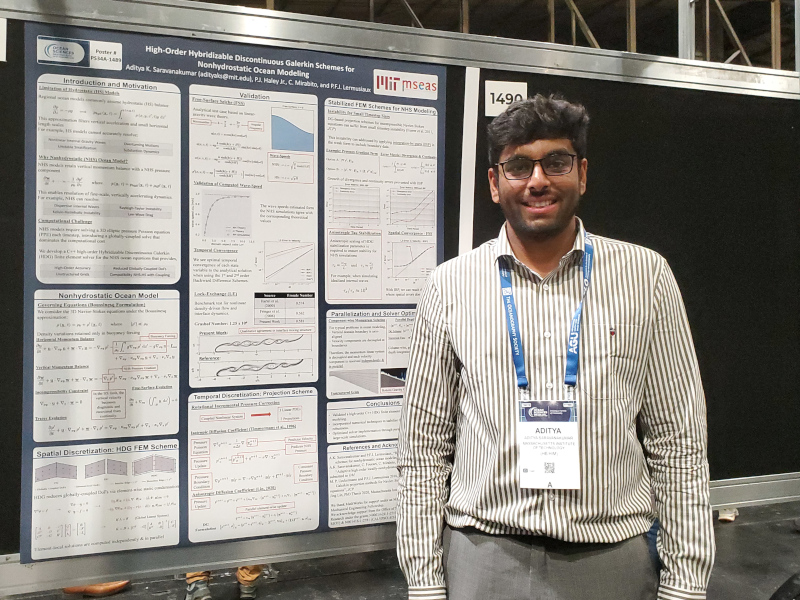
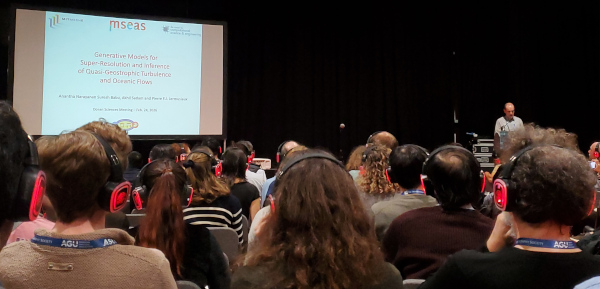
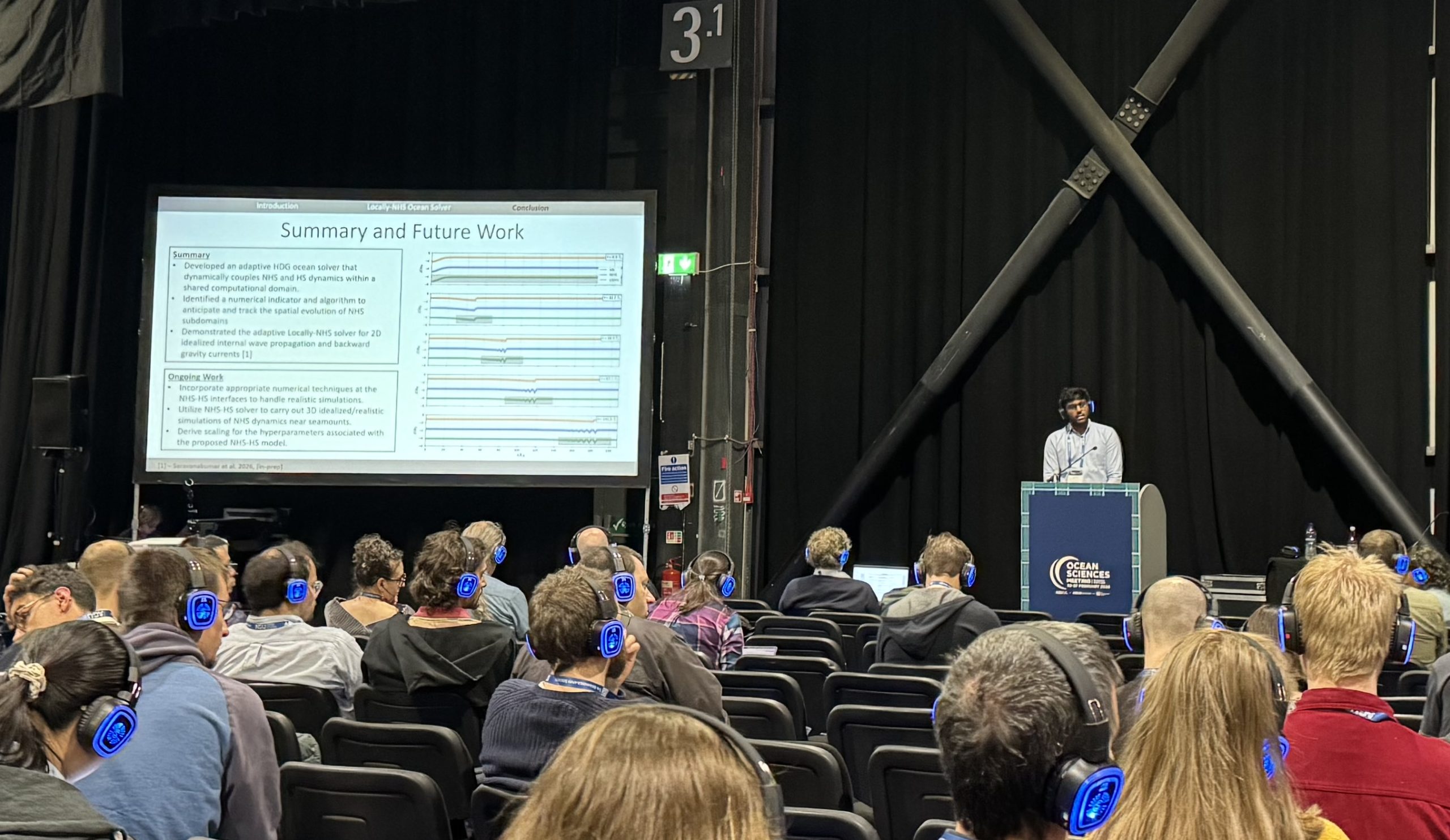
MSEAS Presents at Ocean Sciences 2026 in Glasgow!

MSEAS was well represented this year at OSM in Glasgow, and our work seemed to attract quite a crowd! Congratulations to Aditya, Chris, and Pierre, and to all authors of talks and posters!!

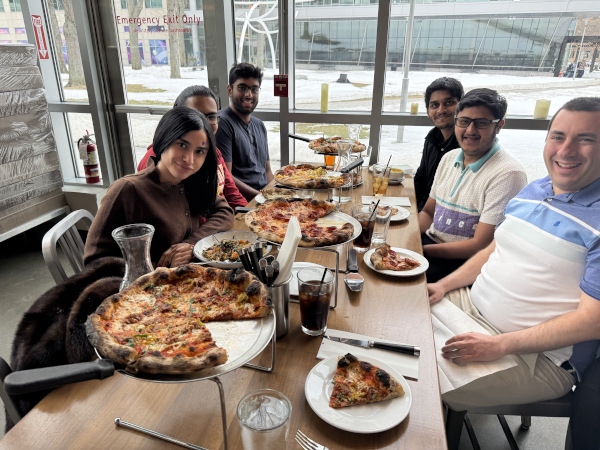
Happy Birthday Sanaa!

On February 17, 2026, we had a group lunch at Area Four to celebrate Sanaa’s birthday (and to mark the start of the spring semester)…

Ocean Acoustic Applications of an Autonomous Underwater Vehicle at the New England Shelfbreak

Speaker: Natalie Kukshtel
[Announcement (PDF)]

Speaker Affiliation: PhD Candidate, MIT-WHOI Joint Program, Woods Hole, MA
Date: Friday, February 20, 2026 at 2:00 p.m., in 3-376 and on Zoom

Abstract: Oceanography is an inherently interdisciplinary field, with many interconnected processes of varying spatiotemporal scales contributing to a dynamic ocean environment. Underwater acoustics is a valuable tool for studying these oceanographic processes, as environmental variability greatly influences acoustic propagation and scattering. The work in this dissertation follows an interdisciplinary approach to explore the multifaceted connections between acoustics and different branches of oceanography. An autonomous underwater vehicle (AUV) was used to study physical, biological, and geological oceanography and their joint acoustic effects as part of the New England Shelf Break Acoustics (NESBA) experiment. The AUV, a modified REMUS 600 equipped with an onboard 2.5-4.5 kHz transducer and towed hydrophone array, was deployed among a network of oceanographic and transceiver moorings. Acoustic signals transmitted and received throughout this network were used to analyze the physical links between environmental variability and acoustic propagation and scattering effects. These contributions further highlight the versatile role of AUVs in advancing ocean acoustic research.

In this work, the AUV was first localized using an acoustics-based multi-channel backpropagation approach, as accurate localization of the vehicle is crucial for contextualizing the AUV data. This process involved back-propagating acoustic wavefronts between the AUV source and mooring hydrophones, as well as signals transmitted from a ship-towed source to the AUV array. Analyses on physical oceanographic uncertainty and mooring tilt were performed to further improve the localization result and understand the influence of environmental uncertainty. Next, the same AUV acoustic dataset was used to explore mid-frequency 3D bathymetric reflection and scattering at a submarine landslide. Computational acoustic modeling, including ray tracing and parabolic equation models, were used to recreate the complex seafloor-interacting acoustic arrival patterns observed in the data, with the final data-model comparison showing evidence of 3D out-of-plane acoustic reflection and scattering. Finally, mid-frequency biological attenuation of a mesopelagic deep scattering layer (DSL) was investigated. A swimbladdered-fish scattering model was used to estimate DSL biological attenuation, which was then applied to a comparison of two acoustic propagation paths traveling through and avoiding the layer, respectively. The final results emphasize the joint influence of biological scattering and physical oceanographic uncertainty on sound propagation.

Energetic Pathways of Mesoscale Eddy Merging and Splitting in the Balearic Sea from a Four-Dimensional Glider Survey

Mesoscale features and their related submesoscale structures can transport heat, freshwater, and biogeochemical tracers (e.g., phytoplankton, oxygen, and carbon) from the surface to the interior. These structures may grow, decay, and redistribute energy through several dynamical processes. The study examines the evolution of small (~20 km) mesoscale eddies and the associated energetic pathways using a four-dimensional, three-month-long autonomous glider survey in the Balearic Sea, Western Mediterranean. The combined glider fleet covered nearly 15,978 km, accumulated 704 glider days, and completed more than 4,837 dives to depths of 700 m, measuring physical and biogeochemical properties. We investigate how energy is redistributed during mesoscale eddy merging and eddy splitting and how these processes relate to changes in flow divergence, strain, and vertical velocities. Scale-dependent diagnostics, support the presence of enhanced upscale kinetic energy transfer during merging, whereas splitting events exhibit strain-dominated dynamics and diminished cross-scale energy transfer. During eddy merging, vertical velocities reach values of up to 20 m day⁻¹. However, the spatial extent of significant vertical motion decreases, consistent with weakened frontogenesis along the eddy periphery and a redistribution of kinetic energy within the merging eddy. Examination of the baroclinic conversion, quantified through the eddy vertical buoyancy flux ⟨w′b′⟩, suggests higher vertical energy conversion during eddy merging. This is localized within areas where strain and frontogenetic activity occur. Although peak values of vertical energy conversion remain elevated, the fraction of the domain contributing to significant conversion decreases, indicating increasing spatial localization of energetic processes during merging. During eddy splitting, vertical velocities are substantially reduced (less than 10 m day⁻¹) following a frontolytic event in the northern eddy. Eddy splitting reduces positive and negative divergence, as well as eddy kinetic energy. Vertical velocities decrease from 20 m day⁻¹ to 10 m day⁻¹. The related baroclinic conversion declines during splitting, suggesting a decrease in vertical exchange under frontolytic conditions. Analysis of baroclinic energy transfers indicates vertical and horizontal pathways, with vertical conversion having a key role during eddy merging and a decreasing role during eddy splitting. Eddy merging is characterized by enhanced upscale transfer of kinetic energy across mesoscale and submesoscale ranges, whereas eddy splitting shows strain-dominated dynamics and reduced cross-scale energy transfer. The observations indicate that mesoscale eddy merging serves as an efficient mechanism for energy redistribution, while eddy splitting promotes energetic decay and reorganizes the vertical exchange.