
Marcoul Completes MSEAS Visit, and Happy Birthday Lisa!
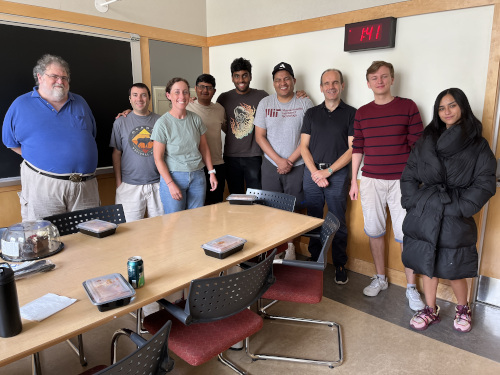
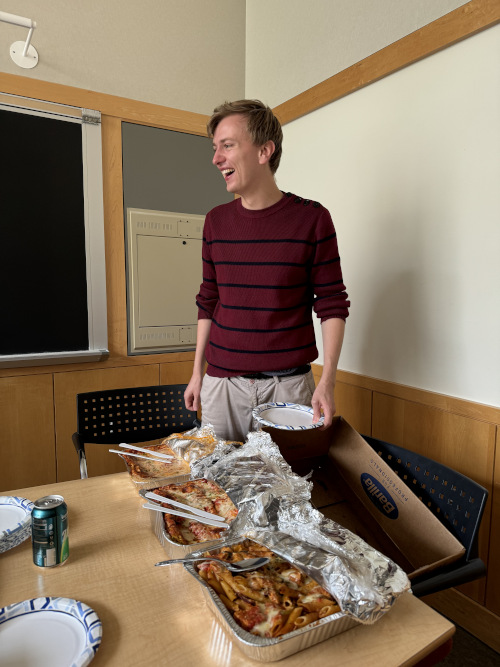
At the end of July, MSEAS had a party with lasagna to celebrate the completion of Marcoul’s visit with us and Lisa’s birthday! All the best for the future Marcoul!!


Loading content ...
At the end of July, MSEAS had a party with lasagna to celebrate the completion of Marcoul’s visit with us and Lisa’s birthday! All the best for the future Marcoul!!
Wael’s and Aaron’s research on Autonomous Sparse-Aperture Multibeam Echo Sounder, as part of the Wide Area Ocean Floor Mapping project, sponsored by MIT Lincoln Lab, has been listed in R&D World’s 2024 R&D 100 Awards. Congratulations to Wael and Aaron!
Congratulations to Anantha Narayanan Suresh Babu, a Ph.D. candidate in the MSEAS group, for being awarded a 2024-2025 MathWorks Mechanical Engineering Fellowship! The competitive MathWorks Engineering Fellowships are awarded to the top nominees from all of the academic departments in the School of Engineering, who use MATLAB and/or Simulink to advance discovery and innovation across disciplines. All the best to Anantha!
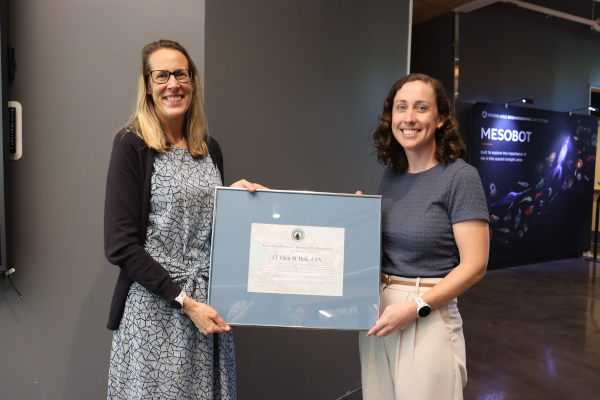
Congratulations to Ellen Mule for winning the Richard Pittenger Fellowship! The Richard Pittenger Fellowship is awarded annually to a U.S. naval officer in the MIT-Woods Hole Oceanographic Institute (WHOI) Joint Program. The fellowship was established to honor the WHOI’s former vice president of marine operations, who retired in 2004 after 14 years at WHOI and 32 years in the Navy, including a tour as Oceanographer of the Navy. He was a strong advocate for science and engineering education for naval officers.
Robin, M.M.N., P.J. Haley, Jr., C. Mirabito, and P.F.J. Lermusiaux, 2024. Dynamically-Orthogonal Parabolic Equations for Probabilistic Ocean Acoustics in the New England Seamounts. In: OCEANS '24 IEEE/MTS Halifax, 23–26 September 2024, pp. 1–8. doi:10.1109/OCEANS55160.2024.10754458
Underwater sound propagation is sensitive to specific environmental features and specific operational configuration parameters. We illustrate the preliminary use of our deterministic and stochastic Dynamically-Orthogonal Wide-Angle Parabolic Equations (DO-WAPEs) to classify and quantify the effects of ocean uncertainties and source depth uncertainties on the acoustic fields. We showcase initial results for the New England Seamounts off the northeastern US coastline, emphasizing the effects of uncertain source depths and subsurface ocean inflows and acoustic ducts. The stochastic DO-WAPEs predict the probability distribution of the acoustic pressure and transmission loss fields. The mean and standard deviation of the TL field are described and linked to the ocean environment and seamount geometry. Mutual information is predicted to identify the TL locations most informative about the source depth.

