

Lagrangian Data Assimilation and Uncertainty Quantification
Speaker: Dr. Nan Chen
[Announcement (PDF)]
Speaker Affiliation: Department of Mathematics, University of Wisconsin-Madison
Date: Thursday, April 25, 2024 at 10:30 a.m. on Zoom
Abstract: Lagrangian tracers are drifters or floaters that follow a parcel of fluid’s movement. These Lagrangian trajectories are widely used as observations, combined with dynamical or statistical models, to recover the underlying flow field. This is known as Lagrangian data assimilation. In the first part of this talk, I will discuss the general methodology for Lagrangian data assimilation. In addition to the ensemble data assimilation, I will present a mathematical framework that allows analytically solvable Lagrangian data assimilation solutions. I will also show a multiscale data assimilation method combining Lagrangian trajectories with the induced Eulerian measurements. In the second part of the talk, I will discuss a few topics focusing on the uncertainty resulting from the solution of Lagrangian data assimilation. They include quantifying the information gain in the state estimation as a number of tracers, eddy identification in the presence of uncertainty, and optimal design of the locations to deploy additional tracers for uncertainty reduction.
Biography: Nan Chen is an Assistant Professor at the Department of Mathematics, University of Wisconsin-Madison. He is also a faculty affiliate of the Institute for Foundations of Data Science. Dr. Chen received his Ph.D. from the Courant Institute of Mathematical Sciences and the Center of Atmosphere and Ocean Science, New York University (NYU), in 2016. He worked as a postdoc research associate at NYU for two years before joining UW-Madison. Dr. Chen’s research interests lie in applied mathematics, geophysics, complex dynamical systems, stochastic methods, numerical algorithms, and general data science. He is also active in developing dynamical and stochastic models and using these models to analyze and predict real-world phenomena related to atmosphere-ocean science, climate, and other complex systems with the help of real observational data. He is a member of the U.S. CLIVAR Working Group on ENSO Conceptual Models. He has received several awards, including the Kurt O. Friedrichs Prize for an outstanding dissertation in mathematics and the Young Investigator Award from the Office of Naval Research.
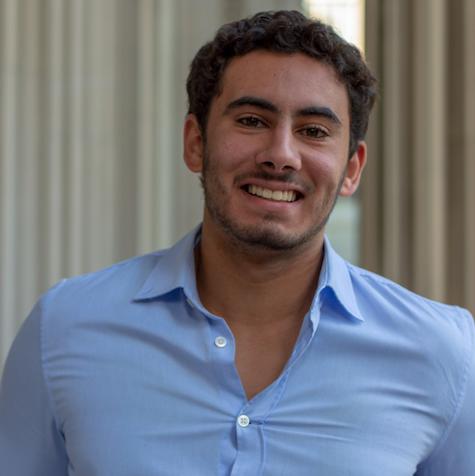


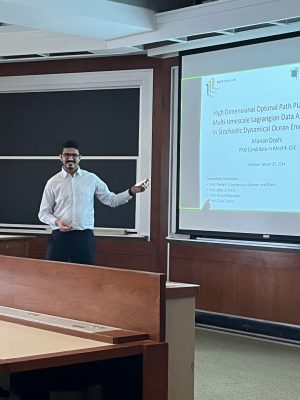 Congratulations to Dr. Manan Doshi on his graduation! Manan successfully defended and received his PhD from Mechanical Engineering for his research on “High Dimensional Optimal Path Planning and Generalized Lagrangian Data Assimilation in Stochastic Dynamical Ocean Environments” with our MSEAS group at MIT. We wish all the best to Manan on plotting his future path!

