headgraphic
loader graphic

Loading content ...

Time-integration Strategies for Non-hydrostatic Atmospheric Models

Speaker: Prof. Francis X. Giraldo
[Announcement (PDF)]

Speaker Affiliation: Department of Applied Mathematics, Naval Postgraduate School, Monterey, CA
Date: Thursday, March 28, 2024 at 11 a.m. on Zoom

Abstract: We begin with a motivation for the challenges faced in weather and climate modeling and then describe why we need special time-integration methods in order to evolve the governing equations forward in time. A quick review of element-based Galerkin (EBG) methods that we use in our models will be given followed by a description of the contravariant form of the discretization that then simplifies the application of horizontally explicit vertically implicit (HEVI) time-integrators regardless of whether we are solving regional or global models. This talk is motivated by my group and collaborators’ research in building operational weather prediction models as well as advancing the field for application in climate, space weather, and ocean dynamics. A list of publications on these topics can be found at: https://frankgiraldo.wixsite.com/mysite/publications

Biography: Francis Giraldo is a distinguished professor in the Department of Applied Mathematics at the Naval Postgraduate School in Monterey, California. He is in the Scientific Computing group and mostly teaches and performs research in this area. For example, he teaches Numerical Linear Algebra, Numerical Analysis, Galerkin Methods, and Scientific Computing. He is also an Adjunct Professor of Applied Mathematics at the University of California at Santa Cruz. His research area is in numerical methods for partial differential equations (PDEs). Although he mainly works on nonlinear systems of hyperbolic equations, he also works on elliptic and parabolic PDEs.

Harmonizing the Virtual Classroom: A Musical Tribute to Class 2.29

In the spring semester of 2021, amidst the upheaval of remote education, the members of class 2.29 “Numerical Fluid Mechanics” navigated the challenges of online learning with grace and resilience. Led by their dedicated Professor Pierre Lermusiaux, supported by TA’s Aaron Charous and Corbin Foucart and administrative assistant Lisa Maxwell, the class embraced virtual tools to foster engagement and collaboration. Throughout the semester, they engaged actively in discussions and presentations using digital platforms. Despite the challenges of distance, the class maintained a sense of camaraderie and enthusiasm. During the final project presentations, Lisa’s ukulele performance added a memorable touch. Singing the lyrics she penned, Lisa’s song served as a heartfelt reminder of their shared journey through remote learning.
The 2.29 Song
Oh yeah we're 2.29
We had our whole class online
In the Spring of '21
Pierre taught twice a week
In a Zoom room he would speak
Can't believe the semester's gone!

Pierre buzzed like a bee
to keep us awake...THAT'S SO MIT!
Where were you at 11:35...?
Crank Nicholson's a finite
Dynamics you're dynamite
It's pahDAY (not PAHday)
you need to derive!

There were equations Euler
(that's quasilinear!),
Taylor Tables and fluid flow...
The first derivative? Give me a sedative!
Let me say (implicitly and explicitly)
where you can go!

That's right we're 2.29!
We had class all online
in the Spring of '21.
We learned lots and lots,
now we're dynamics Hot Shots!
Thanks for being so much fun!

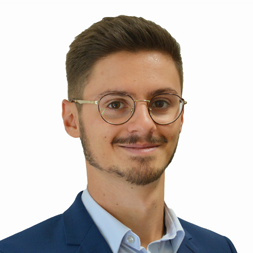
Marcoul Robin

Marcoul is a graduate student in Science and Executive Engineering at École des Mines in Paris, France. Marcoul joined MSEAS in March 2024 as a visiting student. His research interests include Bayesian learning, machine learning and data assimilation for ocean acoustics. He has spent most of his life near the coastal city of Nice, France. Prior to joining MIT, he received his Bachelor’s degree with Honours in Mathematics and Physics from PSL University in Paris. Apart from academia he loves hiking, biking and traveling.

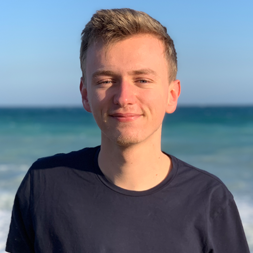
Bastien Schnitzler

Bastien is a PhD student at ISAE-SUPAERO and ENAC in Toulouse, France. He joined MSEAS in March 2024 as a Visiting Student. Bastien is working on trajectory optimization for both airborne drones in wind fields and underwater drones in sea currents. Prior to the PhD, Bastien graduated with a Master of Science in the Design of Intelligent Autonomous Systems from Ecole Polytechnique, Paris, with joint degrees at ISAE-SUPAERO in Aircraft Design and Toulouse University in Operations Research. His research interests are focused on optimal control for airborne platforms as well as aircraft design optimization. Apart from research, he enjoys running, hiking in the Pyrenees and playing tennis.

Trajectory Optimization in Unsteady Flow Fields: The Extremal Approach

Speaker: Bastien Schnitzler
[Announcement (PDF)]

Speaker Affiliation: PhD Candidate, Ecole Nationale de l'Aviation Civile (ENAC), Toulouse, France
Date: Friday, March 8, 2024 at 2 p.m., in 5-314