

Loading content ...
Stochastic Dynamically Orthogonal Modeling and Bayesian Learning for Underwater Acoustic Propagation
Ali, W.H., 2023. Stochastic Dynamically Orthogonal Modeling and Bayesian Learning for Underwater Acoustic Propagation. Ph.D. Thesis, Massachusetts Institute of Technology, Department of Mechanical Engineering and Center for Computational Science and Engineering, September 2023.
Sound waves are critical for a variety of underwater applications including communication, navigation, echo-sounding, environmental monitoring, and marine biology research. However, the incomplete knowledge of the ocean environment and acoustic parameters makes reliable acoustic predictions challenging. This is due to the sparse and heterogeneous data, as well as to the complex ocean physics and acoustics dynamics, multiscale interactions, and large dimensions. There are thus several sources of uncertainty in acoustic predictions. They include the ocean current, temperature, salinity, pressure, density, and sound speed fields, the bottom topography and seabed fields, the sources and receivers properties, and finally the model equations themselves. The goals of this thesis are to address these challenges. Specifically, we: (1) obtain, solve, and verify differential equations for efficient probabilistic underwater acoustic modeling in uncertain environments; (2) develop theory and implement algorithms for the Bayesian nonlinear inference and learning of the ocean, bathymetry, seabed, and acoustic fields and parameters using sparse data; and (3) demonstrate the new methodologies in a range of underwater acoustic applications and real sea experiments, showcasing new capabilities and leading to improved understanding.
In the first part, we derive, discretize, implement, and verify stochastic differential equations that (i) capture dominant input uncertainties in the environment (e.g., ocean, bathymetry, and seabed) and in the acoustic parameters (e.g. source location, frequency, and bandwidth), and (ii) predict the acoustic pressure fields and their probability distributions, respecting the nonlinear governing equations and non-Gaussian statistics. Starting from the acoustic Parabolic Equation (PE), we develop Dynamically Orthogonal (DO) differential equations for range-optimal acoustic uncertainty quantification. Using DO expansions for the input uncertainties, we develop the reduced-order DO-PEs theory for the Narrow-Angle PE (NAPE) and Pad\’e Wide-Angle PE (WAPE) stochastic partial differential equations (PDEs). We verify the discretized DO-PEs in new stochastic range-independent and range-dependent test cases, and demonstrate their advantages over state-of-the-art methods for uncertainty quantification and wave propagation in random media. Results show that a single DO-PE simulation can accurately predict stochastic range-dependent acoustic fields and their full non-Gaussian probability distributions, with computational savings of several orders of magnitude when compared to direct Monte Carlo methods.
In the second part, we extend recent nonlinear Bayesian data assimilation (DA) to the inference and learning of ocean-bathymetry-seabed-acoustic fields and parameters using sparse acoustic and oceanographic data. We combine the acoustic DO-PEs with Gaussian mixture models (GMMs) to predict probability densities in the DO subspace, allowing for efficient non-Gaussian estimation of state variables, parameters, and model functions themselves. The joint multidisciplinary estimation is enabled by state augmentation where the ocean-acoustic-bathymetry-seabed states and parameters are fit together to GMMs within the DO subspace. The new GMM-DO ocean acoustic inference system is validated by assimilating sparse data to infer the source depth, source frequency, and acoustic and environment fields and parameters in five new high-dimensional inference test cases based on state-of-the-art oceanographic and geoacoustic benchmarks. We evaluate the convergence to inference parameters and quantify the learning skill. Results show that our PDE-based Bayesian learning successfully captures non-Gaussian statistics and acoustic ambiguities. Using Bayes’ law, it provides accurate probability distributions for the multivariate quantities and enables principled learning from noisy, sparse, and indirect data.
In the final part, we integrate our acoustic DO-PEs and GMM-DO frameworks with the MSEAS primitive equation ocean modeling system to enable unprecedented probabilistic forecasting and learning of ocean physics and acoustic pressure and transmission loss (TL) fields, accounting for uncertainties in the ocean, acoustics, bathymetry, and seabed fields. We demonstrate the use of this system for low to mid-frequency propagation with real ocean data assimilation in three regions. The first sea experiment takes place in the western Mediterranean Sea where we showcase the system’s performance in predicting ocean and acoustic probability densities, and assimilating sparse TL and sound speed data for joint ocean physics-acoustics-source depth inversion in deep ocean conditions with steep ridges. In the second application, we simulate stochastic acoustic propagation in Massachusetts Bay around Stellwagen Bank and use our GMM-DO Bayesian inference system to assimilate TL data for acoustic and source depth inversion in shallow dynamics with strong internal waves. Finally, in the third experiment in the New York Bight, we employ our system as a novel probabilistic approach for broadband acoustic modeling and inversion. Overall, our results mark significant progress toward end-to-end ocean-acoustic systems for new ocean exploration and management, risk analysis, and advanced operations.
Sanaa Mouzahir



I hail from the enchanting land of Morocco! I lived in Switzerland for three years, where I did my undergrad at EPFL. During my time at EPFL, I took interest in fields that blend mathematics, engineering, and technology to solve complex problems, which led me to pursue a Masters in computational and data-driven engineering mechanics at Columbia University. In graduate school, I engaged in a diverse array of projects that fueled my passion for exploration and problem-solving. From delving into the intricacies of finite element analysis to harnessing the potential of deep learning algorithms for structural health monitoring, and from optimizing complex systems to extract maximum efficiency, each project has offered a unique opportunity to expand my horizons. After graduating I worked as a quantitative risk analyst in the vibrant New York city! Outside of work, I like belly dancing, travelling, and hanging out with my little brother.
Ellen Marie Mule
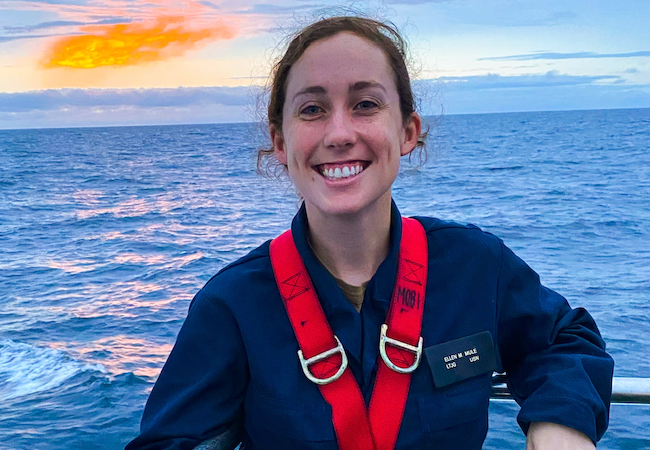
Ellen is a graduate student in the MIT-WHOI Joint Program for Applied Ocean Science and Engineering. A native of Alexandria, VA, she graduated from MIT with a bachelor’s degree in Mechanical and Ocean Engineering in June of 2018. As an undergrad, Ellen was a four-year member of the varsity field hockey team. Following graduation, she commissioned into the United States Navy and served aboard the USS VIRGINIA (SSN 774), a fast-attack submarine based in Portsmouth, NH and Groton, CT. Outside of academics, she enjoys running, cycling, and snowboarding.
High-order Discontinuous Galerkin Methods and Deep Reinforcement Learning with Application to Multiscale Ocean Modeling
Foucart, C., 2023. High-order Discontinuous Galerkin Methods and Deep Reinforcement Learning with Application to Multiscale Ocean Modeling. Ph.D. Thesis, Massachusetts Institute of Technology, Department of Mechanical Engineering and Center for Computational Science and Engineering, September 2023.
With the expanding availability of computational power, numerical modeling plays an increasingly pivotal role in the field of oceanography, enabling scientists to explore and understand ocean processes which are otherwise inaccessible or challenging to observe directly. It provides a crucial tool for investigating a range of phenomena from large-scale circulation patterns to small-scale turbulence, shaping our understanding of marine ecosystems, global climate, and weather patterns. However, this same wide range of spatiotemporal scales presents a distinct computational challenge in capturing physical interactions extending from the diffusive scale (millimeters, seconds) to planetary length scales spanning thousands of kilometers and time scales spanning millennia. Therefore, numerical and parameterization improvements have and will continue to define the state of the art in ocean modeling, in tandem with the integration of observational data and adaptive methods. As scientists strive to better understand multiscale ocean processes, the thirst for comprehensive simulations has proceeded apace with concomitant increases in computing power, and submesoscale resolutions where nonhydrostatic effects are important are progressively becoming approachable in ocean modeling. However, few realistic ocean circulation models presently have nonhydrostatic capability, and those that do overwhelmingly use low-order finite-difference and finite-volume methods, which are plagued by dispersive errors, and are arduous to utilize in general, especially on unstructured domains and in conjunction with adaptive numerical capabilities. High-order discontinuous Galerkin (DG) finite element methods (FEMs) allow for arbitrarily high-order solutions on unstructured meshes and often out-compete low-order models with respect to accuracy per computational cost, providing significant reduction of dispersion and dissipation errors over long-time integration horizons. These properties make DG-FEMs ideal for the next generation of ocean models, and, in this thesis, we develop a novel DG-FEM ocean model with the above longer-term vision and adaptive multiscale capabilities in mind.
Using a novel hybridizable discontinuous Galerkin (HDG) spatial discretization for both the hydrostatic and nonhydrostatic ocean equations with a free surface, we develop an accurate and efficient high-order finite element ocean model. We emphasize the stability and robustness properties of our schemes within a projection method discretization. We provide detailed benchmarking and performance comparisons for the parallelized implementation, tailored to the specifics of HDG finite element methods. We demonstrate that the model achieves optimal convergence, and is capable of accurately simulating nonhydrostatic behavior. We evaluate our simulations in diverse dynamical regimes including linear gravity waves, internal solitary waves, and the formation of Rayleigh-Taylor instabilities in the mixed layer. Motivated by investigating local nonhydrostatic submesoscale dynamics using realistic ocean simulation data, we develop schemes to initialize and nest the new DG-FEM model within a comprehensive hydrostatic ocean modeling system. Nested within such data-assimilative hydrostatic simulations in the Alboran Sea, we provide a demonstration of our new model’s ability to capture both hydrostatic and nonhydrostatic dynamics that arise in the presence of wind-forced instabilities in the upper ocean layers. We show that such a model can both validate and work in tandem with larger hydrostatic modeling systems, enabling multi-dynamics simulations and enhancing the predictive fidelity of ocean forecasts.
Next, as DG-FEM methods are well-suited to adaptive refinement, we develop a method to learn new adaptive mesh refinement strategies directly from numerical simulation by formulating the adaptive mesh refinement (AMR) process as a reinforcement learning problem. Finite element discretizations of problems in computational physics can usefully rely on adaptive mesh refinement to preferentially resolve regions containing important features during simulation. However, most spatial refinement strategies are heuristic and rely on domain-specific knowledge or trial-and-error. We treat the process of adaptive mesh refinement as a local, sequential decision-making problem under incomplete information, formulating AMR as a partially observable Markov decision process. Using a deep reinforcement learning (DRL) approach, we train policy networks for AMR strategy directly from numerical simulation. The training process does not require an exact solution or a high-fidelity ground truth to the partial differential equation (PDE) at hand, nor does it require a pre-computed training dataset. The local nature of our deep reinforcement learning approach allows the policy network to be trained inexpensively on much smaller problems than those on which they are deployed, and the DRL-AMR learning process we devise is not specific to any particular PDE, problem dimension, or numerical discretization. The RL policy networks, trained on simple examples, can generalize to more complex problems and can flexibly incorporate diverse problem physics. To that end, we apply the method to a range of PDEs relevant to fluid and ocean processes, using a variety of high-order discontinuous Galerkin and hybridizable discontinuous Galerkin finite element discretizations. We show that the resultant learned policies are competitive with common AMR heuristics and strike a favorable balance between accuracy and cost such that they often lead to a higher accuracy per problem degree of freedom, and are effective across a wide class of PDEs and problems.

