
headgraphic
loader graphic

Loading content ...

Quantifying, predicting, and exploiting uncertainties in marine environments

Rixen, M., P.F.J. Lermusiaux and J. Osler, 2012. Quantifying, Predicting and Exploiting Uncertainties in Marine Environments, Ocean Dynamics, 62(3):495–499, doi: 10.1007/s10236-012-0526-8.

Following the scientific, technical and field trial initiatives ongoing since the Maritime Rapid Environmental Assessment (MREA) conferences in 2003, 2004 and 2007, the MREA10 conference provided a timely opportunity to review the progress on various aspects of MREA, with a particular emphasis on marine environmental uncertainty management. A key objective of the conference was to review the present state-of-the art in Quantifying, Predicting and Exploiting (QPE) marine environmental uncertainties. The integration of emerging environmental monitoring and modeling techniques into data assimilation streams and their subsequent exploitation at an operational level involves a complex chain of non-linear uncertainty transfers, including human factors. Accordingly the themes for the MREA10 conference were selected to develop a better understanding of uncertainty, from its inception in the properties being measured and instrumentation employed, to its eventual impact in the applications that rely upon environmental information.

Contributions from the scientific community were encouraged on all aspects of environmental uncertainties: their quantification, prediction, understanding and exploitation. Contributions from operational communities, the consumers of environmental information who have to cope with uncertainty, were also encouraged. All temporal and spatial scales were relevant: tactical, operational, and strategic, including uncertainty studies for topics with long-term implications. Manuscripts reporting new technical and theoretical developments in MREA, but acknowledging effects of uncertainties to be accounted for in future research, were also included.

The response was excellent with 87 oral presentations (11 of which were invited keynote speakers) and 24 poster presentations during the conference. A subset of these presentations was submitted to this topical issue and 22 manuscripts have been published by Ocean Dynamics.

Dynamical criteria for the evolution of the stochastic dimensionality in flows with uncertainty

Sapsis, T.P. and P.F.J. Lermusiaux, 2012. Dynamical criteria for the evolution of the stochastic dimensionality in flows with uncertainty. Physica D, 241(1), 60-76, doi:10.1016/j.physd.2011.10.001.

We estimate and study the evolution of the dominant dimensionality of dynamical systems with uncertainty governed by stochastic partial differential equations, within the context of dynamically orthogonal (DO) field equations. Transient nonlinear dynamics, irregular data and non-stationary statistics are typical in a large range of applications such as oceanic and atmospheric flow estimation. To efficiently quantify uncertainties in such systems, it is essential to vary the dimensionality of the stochastic subspace with time. An objective here is to provide criteria to do so, working directly with the original equations of the dynamical system under study and its DO representation. We first analyze the scaling of the computational cost of these DO equations with the stochastic dimensionality and show that unlike many other stochastic methods the DO equations do not suffer from the curse of dimensionality. Subsequently, we present the new adaptive criteria for the variation of the stochastic dimensionality based on instantaneous i) stability arguments and ii) Bayesian data updates. We then illustrate the capabilities of the derived criteria to resolve the transient dynamics of two 2D stochastic fluid flows, specifically a double-gyre wind-driven circulation and a lid-driven cavity flow in a basin. In these two applications, we focus on the growth of uncertainty due to internal instabilities in deterministic flows. We consider a range of flow conditions described by varied Reynolds numbers and we study and compare the evolution of the uncertainty estimates under these varied conditions.

Prof. Lermusiaux gives invited presentation at Gloucester’s New Maritime Port Economy Summit

Prof. Lermusiaux was invited to give a presentation on “Ocean Modeling and Data Assimilation for the Maritime Industry” at the Gloucester (MA) New Maritime Port Economy Summit on November 15, 2011. More information on the summit is available at this web site. A PDF copy of his presentation is available here.

Sources of baroclinic tidal energy in the Gaoping Submarine Canyon off southwestern Taiwan

Speaker: Ming-Da Chiou [Announcement (PDF)]
Speaker Affiliation: Institute of Oceanography, National Taiwan University
Date: Friday, 21 Oct. at 2:00 PM in Room 5-314

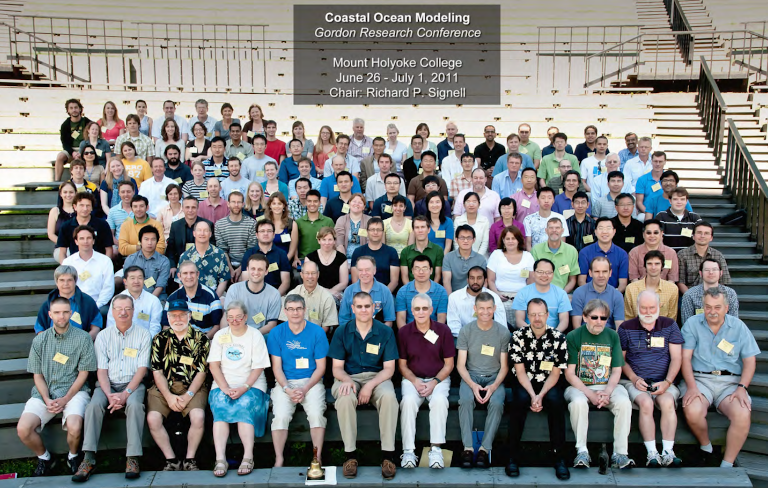
MSEAS Presents Research at the Coastal Ocean Modeling Gordon Research Conference

Prof. Pierre Lermusiaux was one of the presenters at the Coastal Ocean Modeling Gordon Research Conference, held at Mount Holyoke College from June 26 to July 1, 2011. His presentation was titled “PDEs for Ocean Uncertainty Prediction, Nonlinear Data Assimilation and Adaptive Sampling Swarms.”