headgraphic
loader graphic

Loading content ...

Editorial – Ocean Dynamics in 2024: Overview and Thank You to Reviewers

Ezer, T., A. Bonaduce, S. Carniel, C. Amin, R. de Camargo, S.N. Estrada-Allis, O.B. Fringer, A. Gangopadhyay, G. Gao, P.F.J. Lermusiaux, Z. Liu, Y. Miyazawa, A.O. Forster, A. Pinones, E. Stanev, C. Sun, C. Volker, J. Wang, F. Xu, and E. Young, 2025. Editorial – Ocean Dynamics in 2024: Overview and Thank You to Reviewers. Ocean Dynamics 75(1). doi:10.1007/s10236-024-01658-z

Trajectory Optimization for Long-Range Light Vehicles in Unsteady Flow Fields with Obstacles, Diffuse Hazard and Uncertainty

Schnitzler, B., 2024. Trajectory Optimization for Long-Range Light Vehicles in Unsteady Flow Fields with Obstacles, Diffuse Hazard and Uncertainty. Ph.D. Thesis, National School of Aeronautics and Space (ISAE) and University of Toulouse, December 2024.

Continuous progress on developing ever better, safer and more autonomous cyber-physical systems has brought the need for efficient and optimal automatic decision making. Long-range mission drones especially, whether flying in atmospheric wind fields or diving in oceanic currents, are faced with the challenge to optimally plan the route they follow to fulfill their mission in a highly dynamic, unfavorable and uncertain environment, on space scales of hundreds or thousands of kilometers and on time windows spanning tenths of hours or several days.

In this thesis, solving such routing problems for long-range airborne or underwater vehicles is the main focus. The routing problems tackled consist in traveling optimally from a given point to a destination in a strong, unsteady and uncertain flow field, in the presence of diffuse hazard and strictly forbidden zones, with key metrics being travel time, spent energy or exposure to hazard. The considered environment geometries are either the planar 2D space or the Earth’s 2D spherical space. The methods at stake are indirect methods, whether using extremals from Pontryagin’s Maximum Principle or solving numerically a relevant Hamilton-Jacobi-Bellman equation.

First, the properties of an extremal-based algorithm to compute time-optimal trajectories in an unsteady and possibly strong flow field are studied. In given applications cases, similar existing algorithms from the literature are shown to reach their limit. Improvements are proposed for the latter and demonstrated to leverage the encountered caveats. An extension of extremal-based algorithm is then proposed to handle hard obstacles, whether still or moving. The modified algorithm proves capable to compute time-optimal trajectories with obstacles but loses the ability to compute the optimal cost of the problem everywhere in space.

The navigation problem is then extended by adding the speed of the vehicle as a time variable and the total energy expense as an optimization metric. In this framework, the difference between energy-time-optimal trajectories and time-optimal trajectories is studied. On realistic examples, it is shown that an order of magnitude of 10% reduction in energy expense is possible when allowing the vehicle speed to adjust dynamically during the travel.

Hazard is added in the navigation problem as a dynamical and diffuse quantity. A Hamilton-Jacobi-Bellman partial differential equation is solved to get reachability sets for the vehicle in a hazard-physical space, from which hazard-time-optimal trajectories are computed. On realistic settings, it is shown that hazard-time-optimal trajectories are able to avoid a significant amount of hazard in the environment while increasing moderately the total travel time, thus proving the relevance of hazard-time-optimal planning in operational contexts.

Finally, uncertainty is tackled in the planning problem. A most important source of uncertainty comes from the flow field prediction. Weather ensemble predictions provide a collection of possible weather scenarios that help quantify uncertainty in the flow field data. On an airborne problem, the approach consisting in computing time-optimal trajectories in each scenario and simulating the variation in travel time incurred by following the trajectory in different scenarios is evaluated. The average travel time is overall constant over the possible paths, but there exist paths minimizing the dispersion in the travel duration. Next, a PMP formulation on ground paths rather than trajectories is proposed. It enables the writing of differential equations satisfied by extremals candidate to average travel time optimality. These average-time-optimal trajectories are shown to solve for the minimal average travel time in an example, however not with a significant reduction compared to classical time-optimal trajectories in the considered case.

Predictability and Early Warning of Climate Tipping Points

Speaker: Dr. Johannes J. Lohmann
[Announcement (PDF)]

Speaker Affiliation: Niels Bohr Institute, University of Copenhagen, Denmark
Date: Thursday, December 19, 2024 at 11:00 a.m. on Zoom

Abstract: Rising global temperatures lead to mounting stress on societies due to an increased frequency of extreme weather events. This will worsen as the climate continues on its currently projected path, which is a linear function of the greenhouse gas emissions. But there is further concern from paleoclimate data and theoretical considerations that the climate’s response will eventually become non-linear and may feature discontinuous jumps, the so-called tipping points. These are a result of co-existing stable steady states in parts of the Earth system, such as the ice sheets, rainforests and ocean circulation, and they can make climate change partially irreversible even under drastic reduction of the atmospheric CO2 concentrations. State-of-the-art Earth system models show too little agreement to give quantitative estimates on the critical levels of global warming that trigger tipping points. As alternative line of evidence, data-driven methods have been proposed that harness general features of dynamical systems undergoing critical transitions, requiring only little detailed knowledge of the system. Such early-warning signals have been identified in various parts of the climate system, but they are not without caveats. In this talk I will present some recent and ongoing work on the predictability of climate tipping points, focusing on a potential collapse of the Atlantic Ocean circulation. The work shows limitations of commonly used early-warning signals, and proposes improvements using tools from statistical physics to construct optimal observables. I will further briefly discuss work on more fundamental challenges to climate predictability due to high multistability, non-autonomous instabilities, chaos, and fractal basin boundaries.

Biography: Dr. Johannes J. Lohmann received his MSc in physics from TU Berlin and Duke University, and his PhD in climate physics at Copenhagen University (2018). He has been an Assistant professor at NBI since 2021, working in the group for Physics of Ice, Climate and Earth (PICE). He was a Visiting assistant professor at the University of Tokyo in 2023, returning to NBI in 2024. He is currently PI for two projects on climate tipping points funded by DFF and Villum.

UGOS 2024 Annual Meeting

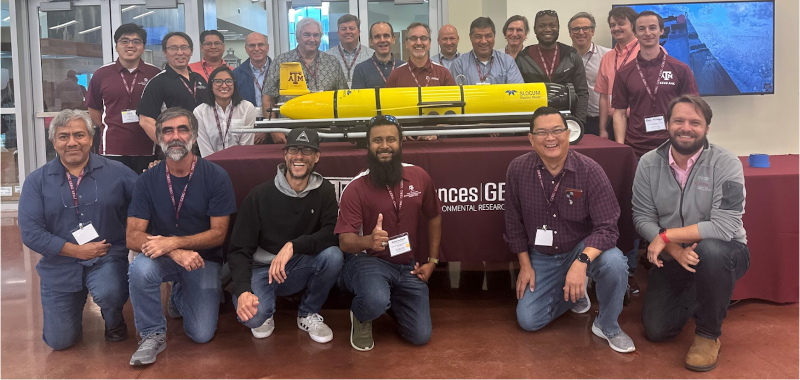
The UGOS 2024 Annual Meeting took place at Texas A&M University in College Station, TX, from September 30 to October 2, 2024. On behalf of MSEAS, Pierre presented MSEAS’ contributions on MASTR Modeling Guidance and Prediction. Afterward, he joined the full UGOS team for a picture (top), and then joined the MASTR team with the glider Stommel that was deployed in the Yucatan Channel during the experiment (bottom):

Acoustic Scattering of Spherical Directional Waves by Smooth and Statistically Rough Solid Elastic Cylinders

Speaker: Miad Al Mursaline
[Announcement (PDF)]

Speaker Affiliation: PhD Candidate, MIT-WHOI Joint Program, Woods Hole, MA
Date: Friday, December 6, 2024 at 4:15 p.m., in 5-314 and on Zoom

Abstract: Realistic sonars radiate spherically spreading waves and have directivity. Therefore, they insonify a target over a finite number of Fresnel zones and span a continuum of oblique incident angles, even when the center of the beam is at normal incidence. These effects strongly influence both the overall scattered pressure levels and resonances. For example, because of the spreading of the beam and associated oblique insonification within the beam, normal modes associated with axially propagating guided waves are excited that would not have otherwise existed for an idealized incident plane wave. This thesis analyzes acoustic scattering by solid elastic cylinders insonified by realistic sonars both theoretically and experimentally. A theoretical model to predict scattering by arbitrary-length cylinders is derived based on the apparent volume flow accounting for the above-mentioned practical sonar properties, namely, spherical spreading and directionality. The formulation is first bench-marked against the formally exact T-matrix solution and tested against previously published laboratory data for finite cylinders. It is found that the formulation outperforms the T-matrix solution in predicting laboratory observations at near-normal incidence. Laboratory experiments are then conducted on arbitrary length smooth cylinders insonified by a directional sonar, with a small number of Fresnel zone excited, to evaluate the theory for monostatic as well as bistatic geometries. The formulation is found to outperform the classical scattering models in predicting the new measurements. For example, resonances associated with axially propagating guided waves excited at broadside incidence observed in the experiments are predicted by the proposed formulation but not by the classical models. The measurements are found to agree well with predictions in terms of overall scattering levels and resonance locations. However, the resonance shapes exhibit inconsistent agreement with data. In addition to testing the predictions, the bistatic laboratory observations presented herein substantiate the significant effects on scattering due to the properties of the incident field from practical sonars. The comparison between theoretical and experimental results is then extended for the more complex case involving statistically rough elastic cylinders with one-dimensional Gaussian roughness. The roughness is found to have a considerable impact on all aspects of scattering—overall levels as well as locations and shapes of resonances. General agreement is found between the theoretically predicted and measured ensemble averaged scattered pressure. Both the theory and data reveal two main observations in the ensemble-averaged scattered field: overall scattered pressure levels are seen to decrease, and resonance effects are diminished compared to the corresponding case of smooth cylinders. Effect of various statistical properties of the rough cylinder, namely, different root mean square (RMS) roughness for fixed correlation length and different correlation lengths for fixed RMS roughness on the scattered field are investigated. Finally, the fluctuations of the scattered field are analyzed using the derived formulation.