headgraphic
loader graphic

Loading content ...

Prof. Lermusiaux named Nam Pyo Suh Professor

Prof. Pierre Lermusiaux has been named Nam Pyo Suh Professor. Prof. Lermusiaux is a nationally and internationally recognized thought leader at the intersection of ocean modeling and observing. Congratulations Pierre!

Sophia Keniston

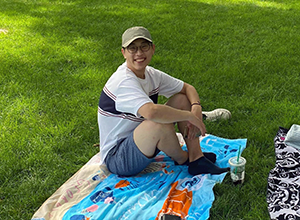
Sophia is currently a senior at Sweet Briar college in Virginia after transferring in from Piedmont Virginia Community College with her Associates degree in Engineering. She will be receiving her Bachelor of Science in Engineering Science in the spring of 2022. Her previous research experiences include working in the Thermodynamics lab at Sweet Briar, and a summer at the University of Virginia doing a study on water quality trading in the state of Virginia. In her free time, she enjoys going on walks and reading fantasy novels. ​

Bayesian Learning of Stochastic Dynamical Models

Lu, P., and P.F.J. Lermusiaux, 2021. Bayesian Learning of Stochastic Dynamical Models. Physica D 427: 133003. doi:10.1016/j.physd.2021.133003

A new methodology for rigorous Bayesian learning of high-dimensional stochastic dynamical models is developed. The methodology performs parallelized computation of marginal likelihoods for multiple candidate models, integrating over all state variable and parameter values, and enabling a principled Bayesian update of model distributions. This is accomplished by leveraging the dynamically orthogonal (DO) evolution equations for uncertainty prediction in a dynamic stochastic subspace and the Gaussian Mixture Model-DO filter for inference of nonlinear state variables and parameters, using reduced-dimension state augmentation to accommodate models featuring uncertain parameters. Overall, the joint Bayesian inference of the state, model equations, geometry, boundary conditions, and initial conditions is performed. Results are exemplified using two high-dimensional, nonlinear simulated fluid and ocean systems. For the first, limited measurements of fluid flow downstream of an obstacle are used to perform joint inference of the obstacle’s shape, the Reynolds number, and the O(105) fluid velocity state variables. For the second, limited measurements of the concentration of a microorganism advected by an uncertain flow are used to perform joint inference of the microorganism’s reaction equation and the O(105) microorganism concentration and ocean velocity state variables. When the observations are sufficiently informative about the learning objectives, we find that our posterior model probabilities correctly identify either the true model or the most plausible models, even in cases where a human would be challenged to do the same.

Neural Closure Models for Dynamical Systems

Gupta, A. and P.F.J. Lermusiaux, 2021. Neural Closure Models for Dynamical Systems. Proceedings of The Royal Society A, 477(2252), pp. 1–29. doi:10.1098/rspa.2020.1004

Complex dynamical systems are used for predictions in many domains. Because of computational costs, models are truncated, coarsened, or aggregated. As the neglected and unresolved terms become important, the utility of model predictions diminishes. We develop a novel, versatile, and rigorous methodology to learn non-Markovian closure parameterizations for known-physics/low-fidelity models using data from high-fidelity simulations. The new neural closure models augment low-fidelity models with neural delay differential equations (nDDEs), motivated by the Mori-Zwanzig formulation and the inherent delays in complex dynamical systems. We demonstrate that neural closures efficiently account for truncated modes in reduced-order-models, capture the effects of subgrid-scale processes in coarse models, and augment the simplification of complex biological and physical-biogeochemical models. We find that using non-Markovian over Markovian closures improves long-term prediction accuracy and requires smaller networks. We derive adjoint equations and network architectures needed to efficiently implement the new discrete and distributed nDDEs, with any time-integration scheme and allowing nonuniformly-spaced temporal training data. The performance of discrete over distributed delays in closure models is explained using information theory, and we find an optimal amount of past information for a specified architecture. Finally, we analyze computational complexity and explain the limited additional cost due to neural closure models.

Manmeet Singh Bhabra

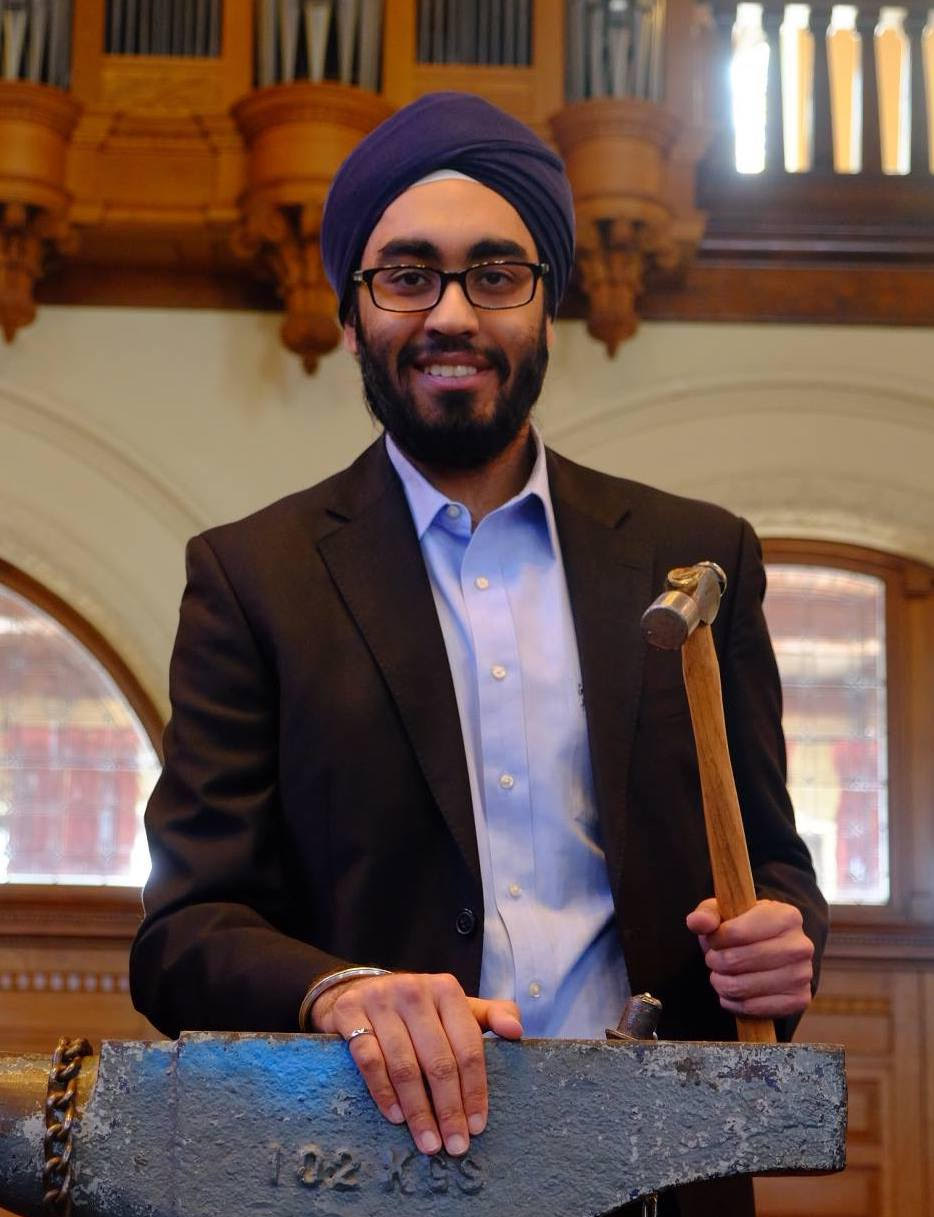
Upon completing his undergraduate studies in Canada, Manmeet started his Master’s in Mechanical Engineering at MIT in Fall 2018. His principal research focus is on high-order numerical methods for underwater acoustic modelling and simulation. In his free time, he enjoys following and playing soccer and basketball. The picture shown here is from what is known as the Iron Ring ceremony, a customary service in Canadian engineering programs. In this ceremony, graduating students are given an Iron Ring (traditionally worn on the pinky finger) as a constant reminder to remain humble and to always live by a high standard of professional conduct. He is currently working on: