

Loading content ...

Clara Dahill

I joined MSEAS in the fall of 2020, pursuing a Masters in Ocean Engineering (SMOE). I am currently an active duty officer in the US Coast Guard, specializing in engineering. I received my Bachelor’s degree in Civil Engineering from the US Coast Guard Academy in Connecticut, where I focused on coastal engineering and stormwater systems. Before MIT I served two tours in Honolulu, HI, as a Naval Engineer-in-Training on Coast Guard ships that patrolled the Pacific Ocean from the Galapagos to the Arctic Circle. I love the ocean and enjoy surfing, free diving, sailing, and paddleboarding.
MSEAS Celebrates Dr. Jing Lin’s PhD
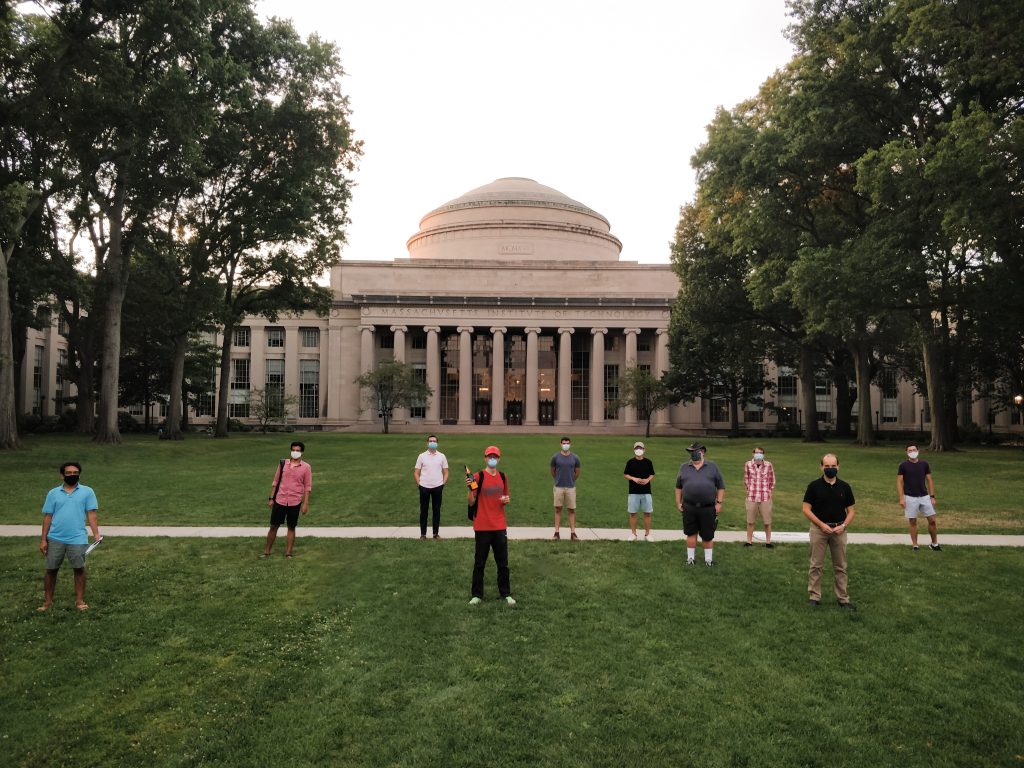
MSEAS member Jing Lin succesfully defended his PhD on August 14, 2020 and the group gathered in the Killian Court to celebrate!
Before Jing’s departure from the US, he and several other MSEAS members went to the zoo.

Congratulations Dr. Jing! We wish you all the best going forward!

Real-time Probabilistic Coupled Ocean Physics-Acoustics Forecasting and Data Assimilation for Underwater GPS
Lermusiaux, P.F.J., C. Mirabito, P.J. Haley, Jr., W.H. Ali, A. Gupta, S. Jana, E. Dorfman, A. Laferriere, A. Kofford, G. Shepard, M. Goldsmith, K. Heaney, E. Coelho, J. Boyle, J. Murray, L. Freitag, and A. Morozov, 2020. Real-time Probabilistic Coupled Ocean Physics-Acoustics Forecasting and Data Assimilation for Underwater GPS. In: OCEANS '20 IEEE/MTS, 5-30 October 2020, pp. 1-9. doi:10.1109/IEEECONF38699.2020.9389003
The widely-used Global Positioning System (GPS) does not work underwater. This presents a severe limitation on the communication capabilities and deployment options for undersea assets such as AUVs and UUVs. To address this challenge, the Positioning System for Deep Ocean Navigation (POSYDON) program aims to develop an undersea system that provides omnipresent, robust positioning across ocean basins. To do so, it is critically important to accurately model sound waves and signals under diverse, and often uncertain, undersea environmental conditions. Probabilistic estimates of the four-dimensional variability of the fields of sound speed, salinity, temperature, and currents are thus needed. In this paper, we employ our MSEAS primitive-equation and error subspace data-assimilative ensemble ocean forecasting system during two real-time POSYDON sea exercises, one in winter 2017 and another in August 2018. We provide real-time high-resolution estimates of sound speed fields and their uncertainty, and describe the ocean conditions from submesoscales eddies and internal tides to warm core rings and larger-scale circulations. We verify our results against independent data of opportunity; in all cases, we show that our probabilistic forecasts demonstrate skill.
Multi-resolution Probabilistic Ocean Physics-Acoustic Modeling: Validation in the New Jersey Continental Shelf
Lermusiaux, P.F.J., P.J. Haley, Jr., C. Mirabito, W.H. Ali, M. Bhabra, P. Abbot, C.-S. Chiu, and C. Emerson, 2020. Multi-resolution Probabilistic Ocean Physics-Acoustic Modeling: Validation in the New Jersey Continental Shelf. In: OCEANS '20 IEEE/MTS, 5-30 October 2020, pp. 1-9. doi:10.1109/IEEECONF38699.2020.9389193
The reliability of sonar systems in the littoral environment is greatly affected by the variability of the surrounding nonlinear ocean dynamics. This variability occurs on multiple scales in space and time, and involves multiple interacting processes, from internal tides and waves to meandering fronts, eddies, boundary layers, and strong air-sea interactions. We utilize our high-resolution MSEAS-PE ocean modeling system to hindcast the ocean physical environment off the New Jersey continental shelf for the end of June 2009, and then utilize our new MSEAS probabilistic acoustic NAPE and WAPE solvers in a coupled ocean physics-acoustic modeling fashion to predict the transmission and integrated transmission losses, respectively. The coupled models are described, and their predictions verified against independent ocean physics observations and sound propagation measurements from acoustic sources and receivers in the region. Our high-resolution ocean simulations are shown to substantial reduce the RMSE and bias of the coarser simulations. Our acoustic simulations of deterministic and stochastic TL fields also show significant skill.

