
headgraphic
loader graphic

Loading content ...

Real-time Ocean Probabilistic Forecasts, Reachability Analysis, and Adaptive Sampling in the Gulf of Mexico

Lermusiaux, P.F.J., P.J. Haley, Jr., C. Mirabito, E.M. Mule, S.F. DiMarco, A. Dancer, X. Ge, A.H. Knap, Y. Liu, S. Mahmud, U.C. Nwankwo, S. Glenn, T.N. Miles, D. Aragon, K. Coleman, M. Smith, M. Leber, R. Ramos, J. Storie, G. Stuart, J. Marble, P. Barros, E.P. Chassignet, A. Bower, H.H. Furey, B. Jaimes de la Cruz, L.K. Shay, M. Tenreiro, E. Pallas Sanz, J. Sheinbaum, P. Perez-Brunius, D. Wilson, J. van Smirren, R. Monreal-Jiménez, D.A. Salas-de-León, V.K. Contreras Tereza, M. Feldman, and M. Khadka, 2024. Real-time Ocean Probabilistic Forecasts, Reachability Analysis, and Adaptive Sampling in the Gulf of Mexico. In: OCEANS '24 IEEE/MTS Halifax, 23–26 September 2024, pp. 1–10. doi:10.1109/OCEANS55160.2024.10754153

The first steps towards integrating autonomous monitoring, probabilistic forecasting, reachability analysis, and adaptive sampling for the Gulf of Mexico were demonstrated in real-time during the collaborative Mini-Adaptive Sampling Test Run (MASTR) ocean experiment, which took place from February to April 2024. The emphasis of this contribution is on the use of the MIT Multidisciplinary Simulation, Estimation, and Assimilation Systems (MSEAS) including Error Subspace Statistical Estimation (ESSE) large-ensemble forecasting and path planning systems to predict ocean fields and uncertainties, forecast reachable sets and optimal paths for gliders, and guide sampling aircraft and ocean vehicles toward the most informative observations. Deterministic and probabilistic ocean forecasts are exemplified and linked to the variability of the Loop Current (LC) and LC Eddies, demonstrating predictive skill by real-time comparisons to independent data. Risk forecasts in terms of probabilities of currents exceeding 1.5 kt were provided. The most informative sampling patterns for Remote Ocean Current Imaging System (ROCIS) flights were forecast using mutual information between surface currents and density anomaly. Finally, we guided four underwater gliders using probabilistic reachability and path-planning forecasts.
Real-time Probabilistic Reachability Forecasting for Gliders in the Gulf of Mexico

Mule, E.M., P.J. Haley, Jr., C. Mirabito, S.F. DiMarco, S. Mahmud, A. Dancer, X. Ge, A.H. Knap, Y. Liu, U.C. Nwankwo, S. Glenn, T.N. Miles, D. Aragon, K. Coleman, M. Smith, M. Leber, R. Ramos, J. Storie, G. Stuart, J. Marble, P. Barros, E.P. Chassignet, A. Bower, H.H. Furey, B. Jaimes de la Cruz, L.K. Shay, M. Tenreiro, E. Pallas Sanz, J. Sheinbaum, P. Perez-Brunius, D. Wilson, J. van Smirren, R. Monreal-Jiménez, D.A. Salas-de-León, V.K. Contreras Tereza, M. Feldman, M. Khadka, and P.F.J. Lermusiaux, 2024. Real-time Probabilistic Reachability Forecasting for Gliders in the Gulf of Mexico. In: OCEANS '24 IEEE/MTS Halifax, 23–26 September 2024, pp. 1–10. doi:10.1109/OCEANS55160.2024.10754057

As part of the Mini-Adaptive Sampling Test Run (MASTR) experiment in the Gulf of Mexico (GoM) region from February to April 2024, we demonstrated real-time deterministic and probabilistic reachability analysis and time-optimal path planning to guide a fleet of four ocean gliders. The governing differential equations for reachability analysis and time-optimal path planning were numerically integrated in real-time and forced by currents from our large-ensemble ocean forecasts. We illustrate the real-time deterministic and probabilistic forward reachability analyses, reachability and path planning for glider pickups, time-optimal path planning for gliders in distress, and planning of future glider deployments. Results show that the actual paths of gliders were contained within our reachable set forecasts and in accord with the dynamic reachability fronts. Our time-optimal headings and paths also predicted real glider motions, even for longer-range predictions of weeks to a month duration. Reachability and time-optimal path planning forecasts were successfully employed for glider recovery. They also enabled exploring options for future glider deployments.

Hazard-Time Optimal Path Planning for Collaborative Air and Sea Drones

Schnitzler, B., P.J. Haley, Jr., C. Mirabito, E.M. Mule, J.-M. Moschetta, D. Delahaye, A. Drouin and P. F. J. Lermusiaux, 2024. Hazard-Time Optimal Path Planning for Collaborative Air and Sea Drones. In: OCEANS '24 IEEE/MTS Halifax, 23–26 September 2024, pp. 1–10. doi:10.1109/OCEANS55160.2024.10753934

General differential equations for multi-objective reachability and optimal planning are used to guide autonomous air and sea drones in hazard-time optimal missions. The vehicles minimize exposure to hazards and travel time, leveraging the dynamic environments with strong flows and steering clear of dynamic hazardous regions. We demonstrate the approach first with an autonomous air drone that crosses the Atlantic Ocean optimizing travel time using trade winds while avoiding hazardous rain storms in the inter-tropical convergence zone. We then consider an air drone that exploits winds and avoids hazardous rains to transport an ocean vehicle to a target destination. The ocean vehicle then completes its own hazard-time optimal mission, leveraging ocean currents and avoiding vessel traffic hazards. In all cases, we predict hazard-time reachable sets, Pareto fronts, and optimal paths. The results highlight the benefits of considering hazards in optimal path planning.

MSEAS runs the show at SIAM MPE!!!

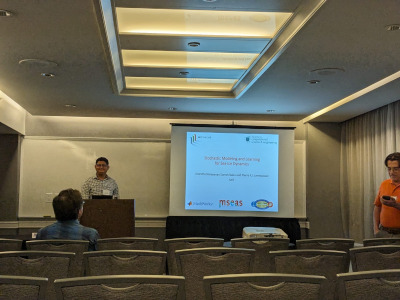
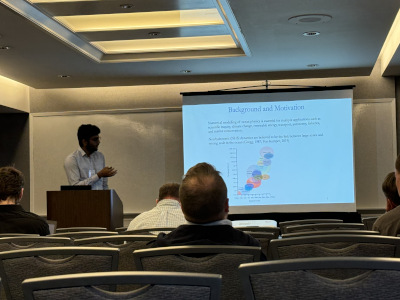
Several members of the MSEAS group gave presentations at the SIAM MPE conference in Portland, Oregon. Congrats to Aditya, Anantha, and Pierre! But everyone from MSEAS was there in spirit, especially Sanaa, Alonso, Pat, and Chris, who were co-authors on the presentations.

Efficient Bayesian Data Assimilation Schemes for Multi-Timescales Coupled Dynamical Systems