
headgraphic
loader graphic

Loading content ...

Stable Rank-adaptive Dynamically Orthogonal Runge-Kutta Schemes

Charous, A. and P.F.J. Lermusiaux, 2024. Stable Rank-adaptive Dynamically Orthogonal Runge-Kutta Schemes. SIAM Journal on Scientific Computing 46(1), A529-A560. doi:10.1137/22M1534948

We develop two new sets of stable, rank-adaptive Dynamically Orthogonal Runge-Kutta (DORK) schemes that capture the high-order curvature of the nonlinear low-rank manifold. The DORK schemes asymptotically approximate the truncated singular value decomposition at a greatly reduced cost while preserving mode continuity using newly derived retractions. We show that arbitrarily high-order optimal perturbative retractions can be obtained, and we prove that these new retractions are stable. In addition, we demonstrate that repeatedly applying retractions yields a gradient-descent algorithm on the low-rank manifold that converges geometrically when approximating a low-rank matrix. When approximating a higher-rank matrix, iterations converge linearly to the best low-rank approximation. We then develop a rank-adaptive retraction that is robust to overapproximation. Building off of these retractions, we derive two novel, rank-adaptive integration schemes that dynamically update the subspace upon which the system dynamics is projected within each time-step: the stable, optimal Dynamically Orthogonal Runge-Kutta (so-DORK) and gradient-descent Dynamically Orthogonal Runge-Kutta (gd-DORK) schemes. These integration schemes are numerically evaluated and compared on an ill-conditioned matrix differential equation, an advection-diffusion partial differential equation, and a nonlinear, stochastic reaction-diffusion partial differential equation. Results show a reduced error accumulation rate with the new stable, optimal and gradient-descent integrators. In addition, we find that rank adaptation allows for highly accurate solutions while preserving computational efficiency.
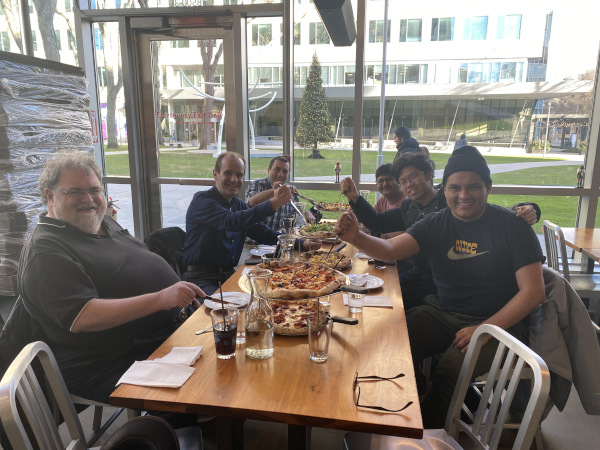

MSEAS Pizza Party!!

It was good…

Stranding Risk for Underactuated Vessels in Complex Ocean Currents: Analysis and Controllers

Doering, A., M. Wiggert, H. Krasowski, M. Doshi, P.F.J. Lermusiaux, and C.J. Tomlin, 2023. Stranding Risk for Underactuated Vessels in Complex Ocean Currents: Analysis and Controllers. In: 2023 IEEE 62nd Conference on Decision and Control (CDC), Singapore. doi:10.1109/CDC49753.2023.10383383

Low-propulsion vessels can take advantage of powerful ocean currents to navigate towards a destination. Recent results demonstrated that vessels can reach their destination with high probability despite forecast errors. However, these results do not consider the critical aspect of safety of such vessels: because their propulsion is much smaller than the magnitude of surrounding currents, they might end up in currents that inevitably push them into unsafe areas such as shallow waters, garbage patches, and shipping lanes. In this work, we first investigate the risk of stranding for passively floating vessels in the Northeast Pacific. We find that at least 5.04% would strand within 90 days. Next, we encode the unsafe sets as hard constraints into Hamilton-Jacobi Multi-Time Reachability to synthesize a feedback policy that is equivalent to re-planning at each time step at low computational cost. While applying this policy guarantees safe operation when the currents are known, in realistic situations only imperfect forecasts are available. Hence, we demonstrate the safety of our approach empirically with large-scale realistic simulations of a vessel navigating in high-risk regions in the Northeast Pacific. We find that applying our policy closed-loop with daily re-planning as new forecasts become available reduces stranding below 1% despite forecast errors often exceeding the maximal propulsion. Our method significantly improves safety over the baselines and still achieves a timely arrival of the vessel at the destination.

Noise Calibration for Geophysical Fluid Dynamics Models

Speaker: Prof. Dan Crisan
[Announcement (PDF)]

Speaker Affiliation: Professor of Mathematics, Faculty of Natural Sciences, Department of Mathematics, Imperial College London, UK
Date: Thursday, December 21, 2023 at 11 a.m. on Zoom

Abstract: Stochastic partial differential equations have been used in a variety of contexts to model the evolution of uncertain dynamical systems. In recent years, their applications to geophysical fluid dynamics has increased massively. For a judicious usage in modelling fluid evolution, one needs to calibrate the amplitude of the noise to data. In this paper we address this requirement for the stochastic rotating shallow water (SRSW) model. This work is a continuation of [1], where a data assimilation methodology has been introduced for the SRSW model. The noise used in [1] was introduced as an arbitrary random phase shift in the Fourier space. This is not necessarily consistent with the uncertainty induced by a model reduction procedure. In this paper, we introduce a new method of noise calibration of the SRSW model which is compatible with the model reduction technique. The method is generic and can be applied to arbitrary stochastic parametrizations. It is also agnostic as to the source of data (real or synthetic). It is based on a principal component analysis technique to generate the eigenvectors and the eigenvalues of the covariance matrix of the stochastic parametrization. For SRSW model covered in this paper, we calibrate the noise by using the elevation variable of the model, as this is an observable easily obtainable in practical application, and use synthetic data as input for the calibration procedure. This is joint work with Alexander Lobbe, Oana Lang, Peter Jan van Leeuwen, and Roland Potthast.

[1] Lang, O., P.J. van Leeuwen, D. Crisan, and R. Potthast, 2022. Bayesian Inference for Fluid Dynamics: A Case Study for the Stochastic Rotating Shallow Water Model. Frontiers in Applied Mathematics and Statistics 8. doi:10.3389/fams.2022.949354

Biography: Dan Crisan is a Professor of Mathematics at the Department of Mathematics of Imperial College London and Director of the EPSRC Centre for Doctoral Training in the Mathematics of Planet Earth. His long-term research interests lie broadly in Stochastic Analysis, a branch of Mathematics that looks at understanding and modelling systems that behave randomly. He is one of the four PIs of the project Stochastic Transport in Upper Ocean Dynamics. This project has received a six-year Synergy ERC award.

Clara Surfs RI Waves From Hurricane Teddy

https://www.abc6.com/high-surf-from-hurricane-teddy-attracts-surfers-from-across-region/