headgraphic
loader graphic

Loading content ...

Aditya Saravanakumar Graduates with S.M. Degree

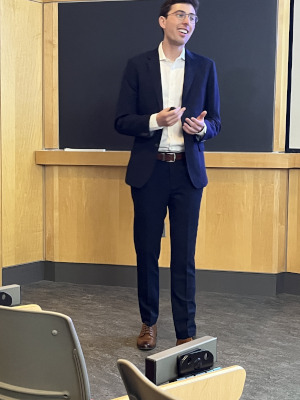
Congratulations to Aditya Saravanakumar on his graduation! Aditya received an SM from Computational Science and Engineering for his research on “Towards Coupled Nonhydrostatic-Hydrostatic Hybridizable Discontinuous Galerkin Method” with our MSEAS group at MIT.

Aaron Charous Graduates with a PhD

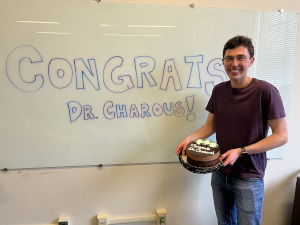
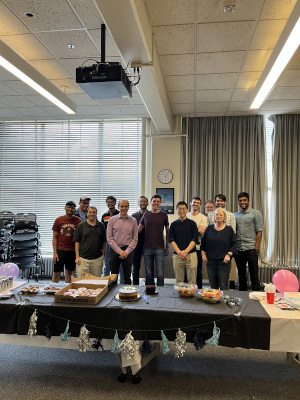
Congratulations to Dr. Aaron Charous on his graduation! Aaron successfully defended and received his PhD from Mechanical Engineering for his research on “Dynamical Reduced-Order Models for High-Dimensional Systems” with our MSEAS group at MIT. We wish all the best to Aaron for his next steps!

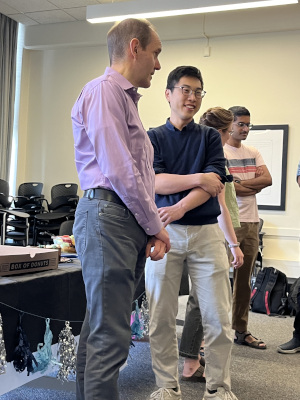
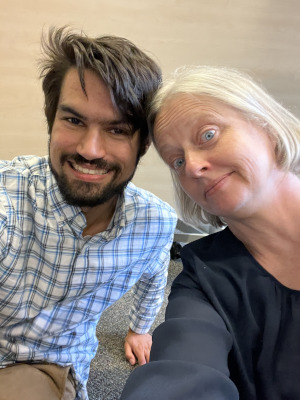
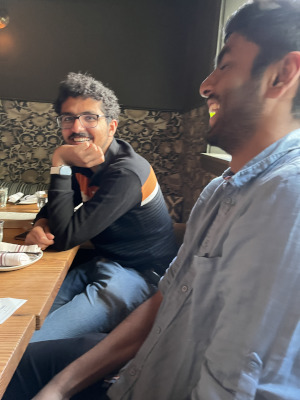
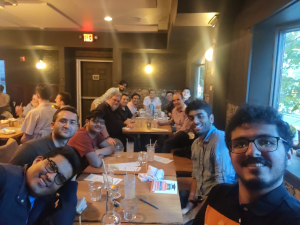
Below are some pictures from graduation:

MSEAS was also introduced to Jeppson’s Malört.

Wael Awarded Wunsch Foundation Silent Hoist and Crane Award

Graduate student Wael Hajj Ali has been awarded a 2023 Wunsch Foundation Silent Hoist and Crane Award for Outstanding Graduate Research and Education by the Department of Mechanical Engineering. Congratulations Wael!

Evaluation of Deep Neural Operator Models toward Ocean Forecasting

Rajagopal, E., A.N.S. Babu, T. Ryu, P.J. Haley, Jr., C. Mirabito, and P.F.J. Lermusiaux, 2023. Evaluation of Deep Neural Operator Models toward Ocean Forecasting. In: OCEANS '23 IEEE/MTS Gulf Coast, 25–28 September 2023. doi:10.23919/OCEANS52994.2023.10337380

Data-driven, deep-learning modeling frameworks have been recently developed for forecasting time series data. Such machine learning models may be useful in multiple domains including the atmospheric and oceanic ones, and in general, the larger fluids community. The present work investigates the possible effectiveness of such deep neural operator models for reproducing and predicting classic fluid flows and simulations of realistic ocean dynamics. We first briefly evaluate the capabilities of such deep neural operator models when trained on a simulated two-dimensional fluid flow past a cylinder. We then investigate their application to forecasting ocean surface circulation in the Middle Atlantic Bight and Massachusetts Bay, learning from high-resolution data-assimilative simulations employed for real sea experiments. We confirm that trained deep neural operator models are capable of predicting idealized periodic eddy shedding. For realistic ocean surface flows and our preliminary study, they can predict several of the features and show some skill, providing potential for future research and applications.

Gaussian Beam Migration for Wide-Area Deep Ocean Floor Mapping

Charous, A., W.H. Ali, P. Ryu, D. Brown, K. Arsenault, B. Cho, K. Rimpau, A. March, and P.F.J. Lermusiaux, 2023. Gaussian Beam Migration for Wide-Area Deep Ocean Floor Mapping. In: OCEANS '23 IEEE/MTS Gulf Coast, 25–28 September 2023. doi:10.23919/OCEANS52994.2023.10337362

Cost-effective seafloor mapping at high resolution is yet to be attained. A possible solution consists of using a mobile, wide-aperture, sparse array with subarrays distributed across multiple autonomous surface vessels. Such wide-area mapping with multiple dynamic sources and receivers require accurate modeling and processing systems for imaging the seabed. In this paper, we focus on computational schemes and challenges for such high-resolution acoustic imaging or migration. Starting from the imaging condition from the adjoint-state method, we derive a closed-form expression for Gaussian beam migration in stratified media. We employ this technique on simulated data and on real data collected with our novel acoustic array over shipwrecks in the Boston Harbor. We compare Gaussian beam migration with diffraction stack and Kirchhoff migration, and we find that Gaussian beam migration produces the clearest images with the fewest artifacts.