
headgraphic
loader graphic

Loading content ...

Energy-Time Optimal Path Planning in Dynamic Flows: Theory and Schemes

Doshi, M.M., M.S. Bhabra, and P.F.J. Lermusiaux, 2023. Energy-Time Optimal Path Planning in Dynamic Flows: Theory and Schemes. Computer Methods in Applied Mechanics and Engineering 405: 115865. doi:10.1016/j.cma.2022.115865

We obtain, solve, and verify fundamental differential equations for energy-time path planning in dynamic flows. The equations govern the energy-time reachable sets, optimal paths, and optimal controls for autonomous vehicles navigating to any destination in known dynamic environments, minimizing both energy usage and travel time. Based on Hamilton-Jacobi theory for reachability and the level set method, the resulting methodology computes the Pareto optimal solutions to the multi-objective path planning problem, numerically solving the exact equations governing the evolution of reachability fronts and optimal paths in the augmented energy and physical-space domain. Our approach is applicable to path planning in various dynamic flow environments and energy types. We first validate the methodology through a benchmark case of crossing a steady jet for which we compare our results to semi-analytical optimal energy-time solutions. We then consider unsteady flow environments and solve for energy-time optimal missions in a quasi-geostrophic double-gyre flow field. Results show that our theory and schemes can provide all the energy-time optimal solutions and that these solutions can be strongly influenced by unsteady flow conditions.

RSI Student Rishab Jain Admitted to Harvard

Rishab Jain, a high school senior who joined MSEAS during summer 2022 as an RSI scholar, was recently admitted to Harvard for the Fall 2023 semester. Congrats Rishab!

Lagrangian Surface Signatures Reveal Upper-Ocean Vertical Displacement Conduits Near Oceanic Density Fronts

Aravind, H.M., V. Verma, S. Sarkar, M.A. Freilich, A. Mahadevan, P.J. Haley Jr., P.F.J. Lermusiaux, and M.R. Allshouse, 2023. Lagrangian Surface Signatures Reveal Upper-Ocean Vertical Displacement Conduits Near Oceanic Density Fronts. Ocean Modelling 181, 102136. doi:10.1016/j.ocemod.2022.102136

Vertical transport in the ocean plays a critical role in the exchange of freshwater, heat, nutrients, and other biogeochemical tracers. While there are situations where vertical fluxes are important, studying the vertical transport and displacement of material requires analysis over a finite interval of time. One such example is the subduction of fluid from the mixed layer into the pycnocline, which is known to occur near density fronts. Divergence has been used to estimate vertical velocities indicating that surface measurements, where observational data is most widely available, can be used to locate these vertical transport conduits. We evaluate the correlation between surface signatures derived from Eulerian (horizontal divergence, density gradient, and vertical velocity) and Lagrangian (dilation rate and finite time Lyapunov exponent) metrics and vertical displacement conduits. Two submesoscale resolving models of density fronts and a data-assimilative model of the western Mediterranean were analyzed. The Lagrangian surface signatures locate significantly more of the strongest displacement features and the difference in the expected displacements relative to Eulerian ones increases with the length of the time interval considered. Ensemble analysis of forecasts from the Mediterranean model demonstrates that the Lagrangian surface signatures can be used to identify regions of strongest downward vertical displacement even without knowledge of the true ocean state.

Submarine Cables as Precursors of Persistent Systems for Large Scale Oceans Monitoring and Autonomous Underwater Vehicles Operation

Tieppo, M., E. Pereira, L. González Garcia, M. Rolim, E. Castanho, A. Matos, A. Silva, B. Ferreira, M. Pascoal, E. Almeida, F. Costa, F. Zabel, J. Faria, J. Azevedo, J. Alves, J. Moutinho, L. Gonçalves, M. Martins, N. Cruz, N. Abreu, P. Silva, R. Viegas, S. Jesus, T. Chen, T. Miranda, A. Papalia, D. Hart, J. Leonard, M. Haji, O. de Weck, P. Godart, and P. Lermusiaux, 2022. Submarine Cables as Precursors of Persistent Systems for Large Scale Oceans Monitoring and Autonomous Underwater Vehicles Operation. In: OCEANS '22 IEEE/MTS Hampton Roads, 17–20 October 2022, pp. 1–7. doi:10.1109/OCEANS47191.2022.9977360

Long-term and reliable marine ecosystems monitoring is essential to address current environmental issues, including climate change and biodiversity threats. The existing oceans monitoring systems show clear data gaps, particularly when considering characteristics such as depth coverage or measured variables in deep and open seas. Over the last decades, the number of fixed and mobile platforms for in situ ocean data acquisition has increased significantly, covering all oceans’ regions. However, these are largely dependent on satellite communications for data transmission, as well as on research cruises or opportunistic ship surveys, generally presenting a lag between data acquisition and availability. In this context, the creation of a widely distributed network of SMART cables (Science Monitoring And Reliable Telecommunications) – sensors attached to submarine telecommunication cables – appears as a promising solution to fill in the current ocean data gaps and ensure unprecedented oceans health continuous monitoring. The K2D (Knowledge and Data from the Deep to Space) project proposes the development of a persistent oceans monitoring network based on the use of telecommunications cables and Autonomous Underwater Vehicles (AUVs). The approach proposed includes several modules for navigation, communication and energy management, that enable the cost-effective gathering of extensive oceans data. These include physical, chemical, and biological variables, both registered with bottom fixed stations and AUVs operating in the water column. The data that can be gathered have multiple potential applications, including oceans health continuous monitoring and the enhancement of existing ocean models. The latter, in combination with geoinformatics and Artificial Intelligence, can create a continuum from the deep sea to near space, by integrating underwater remote sensing and satellite information to describe Earth systems in a holistic manner.

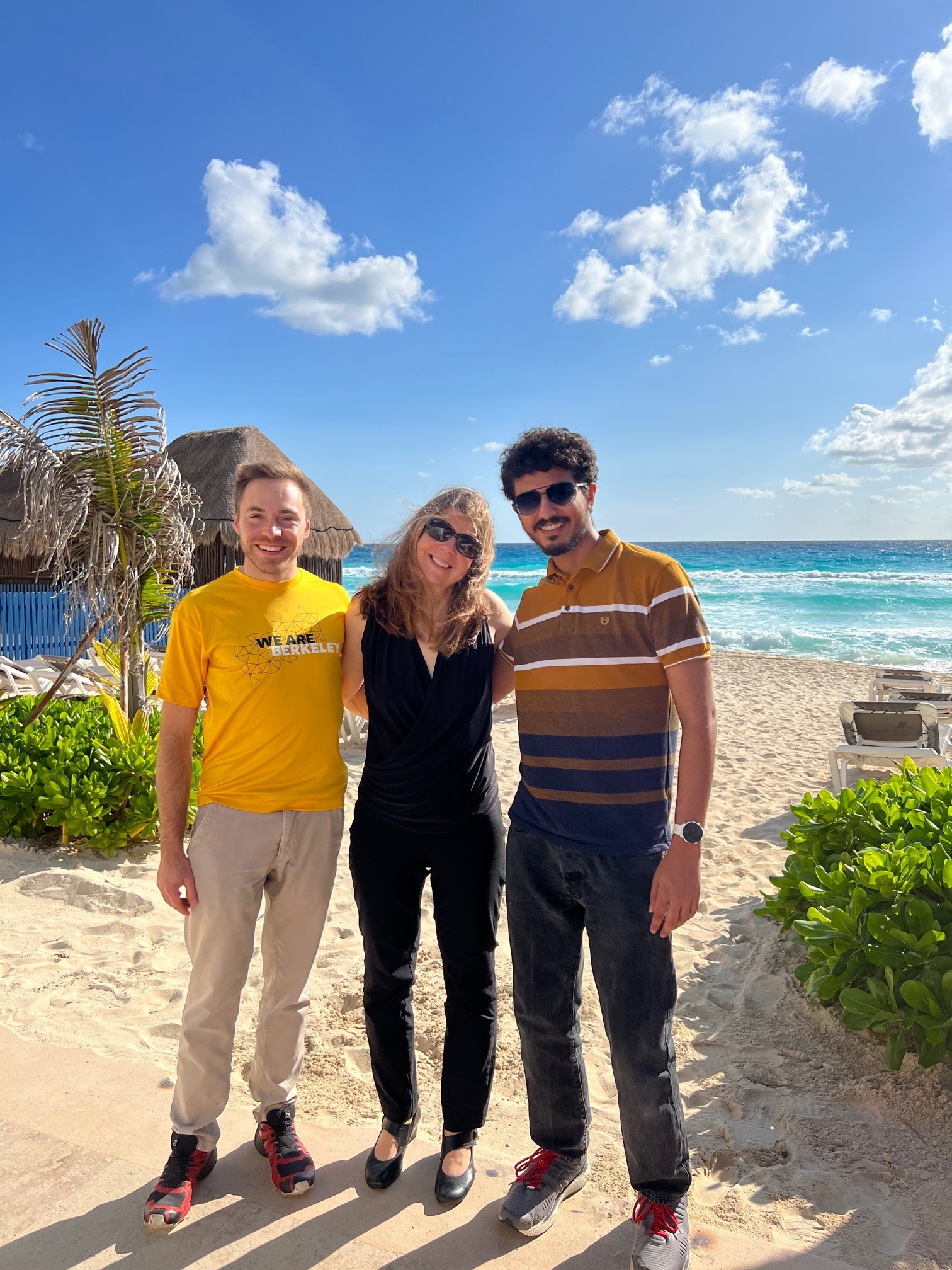
Manan in Full Control at CDC Cancún

Need we say more?