headgraphic
loader graphic

Loading content ...

Bayesian Learning of Stochastic Dynamical Models

Lu, P., and P.F.J. Lermusiaux, 2021. Bayesian Learning of Stochastic Dynamical Models. Physica D 427: 133003. doi:10.1016/j.physd.2021.133003

A new methodology for rigorous Bayesian learning of high-dimensional stochastic dynamical models is developed. The methodology performs parallelized computation of marginal likelihoods for multiple candidate models, integrating over all state variable and parameter values, and enabling a principled Bayesian update of model distributions. This is accomplished by leveraging the dynamically orthogonal (DO) evolution equations for uncertainty prediction in a dynamic stochastic subspace and the Gaussian Mixture Model-DO filter for inference of nonlinear state variables and parameters, using reduced-dimension state augmentation to accommodate models featuring uncertain parameters. Overall, the joint Bayesian inference of the state, model equations, geometry, boundary conditions, and initial conditions is performed. Results are exemplified using two high-dimensional, nonlinear simulated fluid and ocean systems. For the first, limited measurements of fluid flow downstream of an obstacle are used to perform joint inference of the obstacle’s shape, the Reynolds number, and the O(105) fluid velocity state variables. For the second, limited measurements of the concentration of a microorganism advected by an uncertain flow are used to perform joint inference of the microorganism’s reaction equation and the O(105) microorganism concentration and ocean velocity state variables. When the observations are sufficiently informative about the learning objectives, we find that our posterior model probabilities correctly identify either the true model or the most plausible models, even in cases where a human would be challenged to do the same.

Neural Closure Models for Dynamical Systems

Gupta, A. and P.F.J. Lermusiaux, 2021. Neural Closure Models for Dynamical Systems. Proceedings of The Royal Society A, 477(2252), pp. 1–29. doi:10.1098/rspa.2020.1004

Complex dynamical systems are used for predictions in many domains. Because of computational costs, models are truncated, coarsened, or aggregated. As the neglected and unresolved terms become important, the utility of model predictions diminishes. We develop a novel, versatile, and rigorous methodology to learn non-Markovian closure parameterizations for known-physics/low-fidelity models using data from high-fidelity simulations. The new neural closure models augment low-fidelity models with neural delay differential equations (nDDEs), motivated by the Mori-Zwanzig formulation and the inherent delays in complex dynamical systems. We demonstrate that neural closures efficiently account for truncated modes in reduced-order-models, capture the effects of subgrid-scale processes in coarse models, and augment the simplification of complex biological and physical-biogeochemical models. We find that using non-Markovian over Markovian closures improves long-term prediction accuracy and requires smaller networks. We derive adjoint equations and network architectures needed to efficiently implement the new discrete and distributed nDDEs, with any time-integration scheme and allowing nonuniformly-spaced temporal training data. The performance of discrete over distributed delays in closure models is explained using information theory, and we find an optimal amount of past information for a specified architecture. Finally, we analyze computational complexity and explain the limited additional cost due to neural closure models.

Manmeet Singh Bhabra

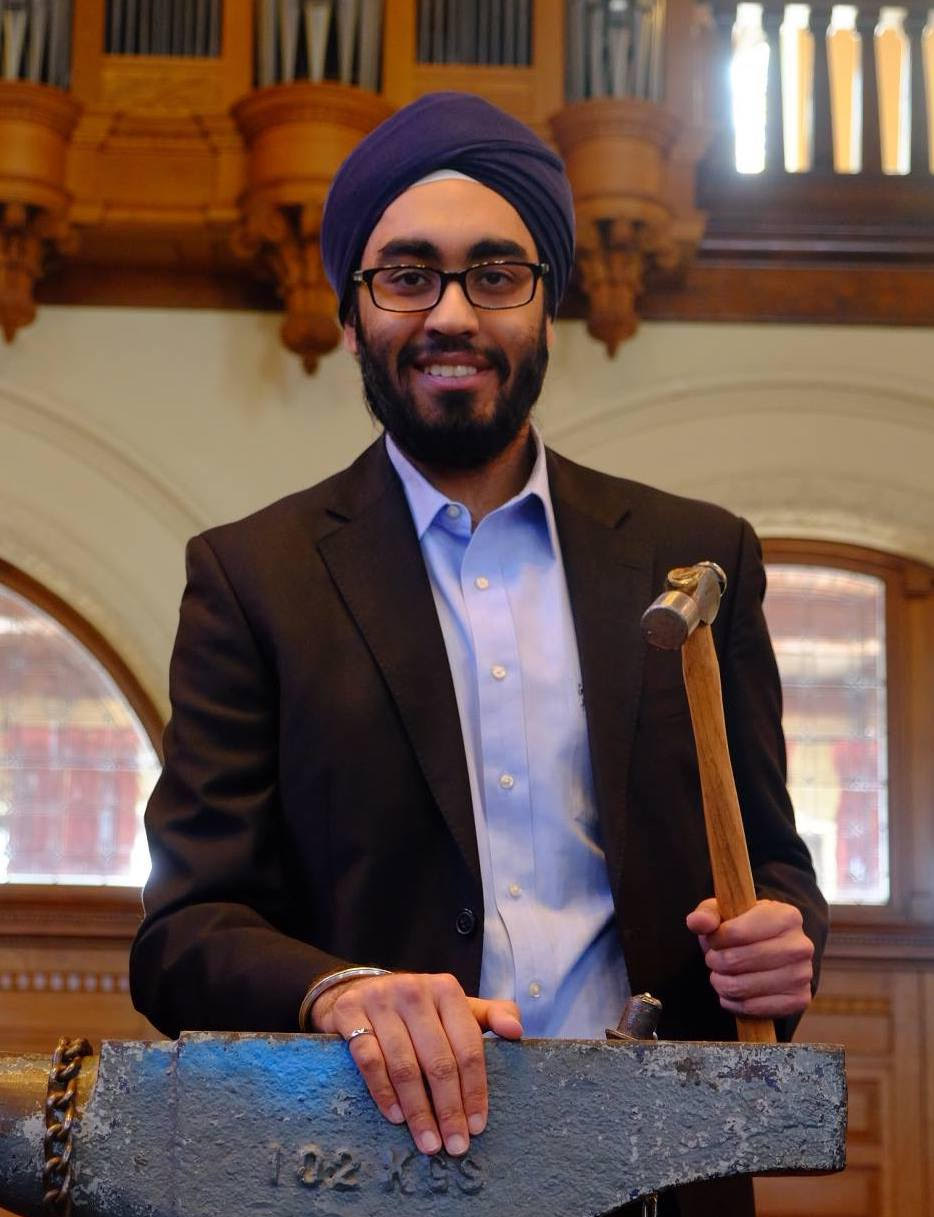
Upon completing his undergraduate studies in Canada, Manmeet started his Master’s in Mechanical Engineering at MIT in Fall 2018. His principal research focus is on high-order numerical methods for underwater acoustic modelling and simulation. In his free time, he enjoys following and playing soccer and basketball. The picture shown here is from what is known as the Iron Ring ceremony, a customary service in Canadian engineering programs. In this ceremony, graduating students are given an Iron Ring (traditionally worn on the pinky finger) as a constant reminder to remain humble and to always live by a high standard of professional conduct. He is currently working on:

METEOR: A Mobile (Portable) ocEan roboTic ObsErvatORy

Rajan, K., F. Aguado, P. Lermusiaux, J. Borges de Sousa, A. Subramaniam, and J. Tintore, 2021. METEOR: A Mobile (Portable) ocEan roboTic ObsErvatORy. Marine Technology Society Journal 55(3): 74-75. doi:10.4031/MTSJ.55.3.42

The oceans make this planet habitable and provide a variety of essential ecosystem services ranging from climate regulation through control of greenhouse gases to provisioning about 17% of protein consumed by humans. The oceans are changing as a consequence of human activity but this system is severely under sampled. Traditional methods of studying the oceans, sailing in straight lines, extrapolating a few point measurements have not changed much in 200 years. Despite the tremendous advances in sampling technologies, we often use our autonomous assets the same way. We propose to use the advances in multiplatform, multidisciplinary, and integrated ocean observation, artificial intelligence, marine robotics, new high-resolution coastal ocean data assimilation techniques and computer models to observe and predict the oceans “intelligently”—by deploying self-propelled autonomous sensors and Smallsats guided by data assimilating models to provide observations to reduce model uncertainty in the coastal ocean. This system will be portable and capable of being deployed rapidly in any ocean.

Tony Ryu

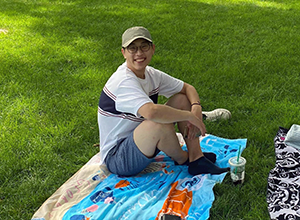
I joined MSEAS in the summer of 2020 as a SM student in Computational Science & Engineering (CSE). I completed my Bachelor’s in Aerospace Engineering at Delft University of Technology in the Netherlands. My current research is on data-driven reduced order modelling methods. Outside of academics, I enjoy soccer and the short bike rides to and from places.