headgraphic
loader graphic

Loading content ...

Ben Koenig receives ASNE Tidewater Section Admiral David Donohue Scholarship for 2021

Congratulations to Ben for receiving the ASNE Tidewater Section Admiral David Donohue Scholarship for 2021! This award is given by the American Society of Naval Engineers each year since 1979, and is given “in order to promote the profession of naval engineering and to encourage college students to enter the field. Since the inception of the Scholarship Program, ASNE has since awarded hundreds of scholarships to undergraduate and graduate students interested in pursuing an education and career in naval engineering.” Congratulations once again to Ben!

Abhinav’s Closure Model Figures Featured on Cover of Proceedings of the Royal Society

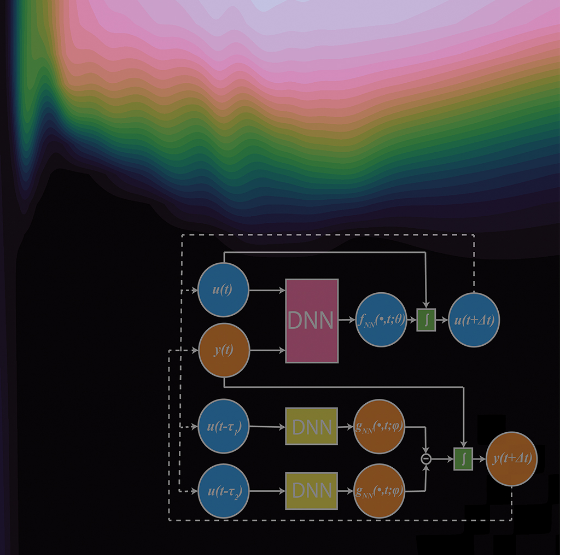
Several figures from Abhinav’s paper “Neural Closure Models for Dynamical Systems” have been featured on the cover of the August 2021 issue of the Proceedings of the Royal Society A. Congratulations to Abhinav!

The background is a spatio-temporal zooplankton field, simulated using a complex nonlinear 5-component 1-D physical-biogeochemical model. Seasonal variability is forced through the surface photosynthetically-available radiation and mixed layer depth, each of which vary in time. The 5-component model is one of the dynamical systems used to illustrate our novel neural closure modeling. Overlaid on the zooplankton field is the graphical representation of the time-discretized distributed neural delay differential equation (Distributed-nDDE). The blocks labeled DNN and the integral symbol represent any deep neural-network architecture and time-integration scheme.

Alonso V. Rodriguez

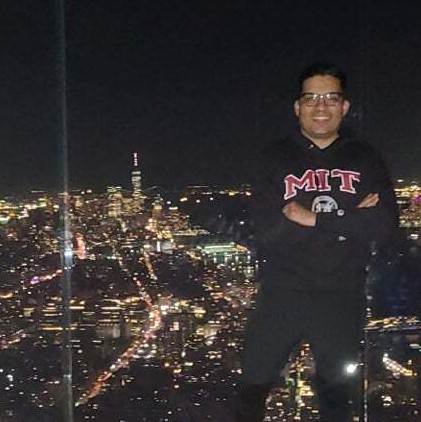
Alonso V. Rodriguez joined the MSEAS group in Fall 2021. He will be focusing on applying the Dynamically Orthogonal Primitive Equations (DO-PE) for realistic high-resolution stochastic ocean forecasting in domains with complicated ocean dynamics to enabling extensive forecast ensembles. He holds a bachelor’s from the New Jersey Institute of Technology. Outside school, Alonso enjoys riding his bike and traveling to recondite places.

Clara and Manan Win Research Prizes at MERE 2021

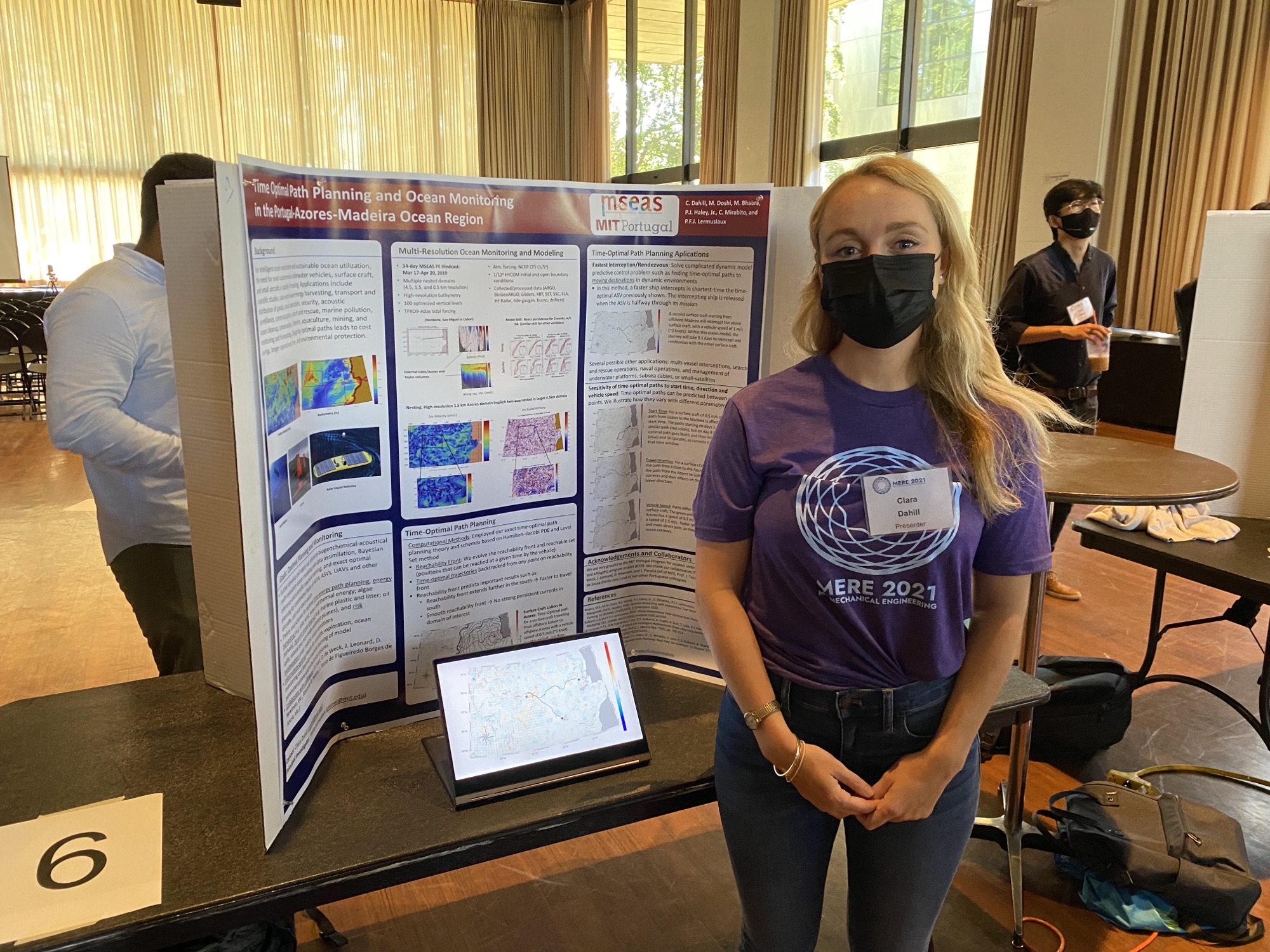
Congratulations to Clara and Manan for their MERE 2021 performance! Clara presented her research on “Time Optimal Path Planning and Ocean Monitoring in the Portugal-Azores-Madeira Ocean Region,” and won the Best First-Time Presenter prize! Meanwhile, Manan presented his research on “Autonomous Path Planning to Optimally Harvest Dynamic Fields,” and received a Runner-up prize! Congratulations again to Clara and Manan!

Click the link for more information about the MERE 2021 Presentation Awards.

Game Theory for Unmanned Vehicles Path Planning in the Marine Domain: State of the Art and New Possibilities

Cococcioni, M., L. Fiaschi, and P.F.J. Lermusiaux, 2021. Game Theory for Unmanned Vehicles Path Planning in the Marine Domain: State of the Art and New Possibilities. Journal of Marine Science and Engineering 9(11), 1175. doi:10.3390/jmse9111175. Special Issue on Machine Learning and Remote Sensing in Ocean Science and Engineering.

Thanks to the advent of new technologies and higher real-time computational capabilities, the use of unmanned vehicles in the marine domain received a significant burst in the last decade. Ocean and seabed sampling, missions in dangerous areas, and civilians security are just a few of the large number of applications which currently benefit from unmanned vehicles. One of the most actively studied topic is their full autonomy, i.e., the design of marine vehicles capable of pursuing a task while reacting to the changes of the environment without the intervention of humans, not even remote. Environment dynamicity may consist in variations of currents, presence of unknown obstacles, and attacks from adversaries (e.g., pirates). To achieve autonomy in such highly dynamic uncertain conditions, many types of autonomous path planning problems need to be solved. There has thus been a commensurate number of approaches and methods to optimize such path planning. This work focuses on game theoretic ones and provides a wide overview of the current state of the art, along with future directions.