headgraphic
loader graphic

Loading content ...

Alonso V. Rodriguez

Alonso V. Rodriguez joined the MSEAS group in Fall 2021. He will be focusing on applying the Dynamically Orthogonal Primitive Equations (DO-PE) for realistic high-resolution stochastic ocean forecasting in domains with complicated ocean dynamics to enabling extensive forecast ensembles. He holds a bachelor’s from the New Jersey Institute of Technology. Outside school, Alonso enjoys riding his bike and traveling to recondite places.

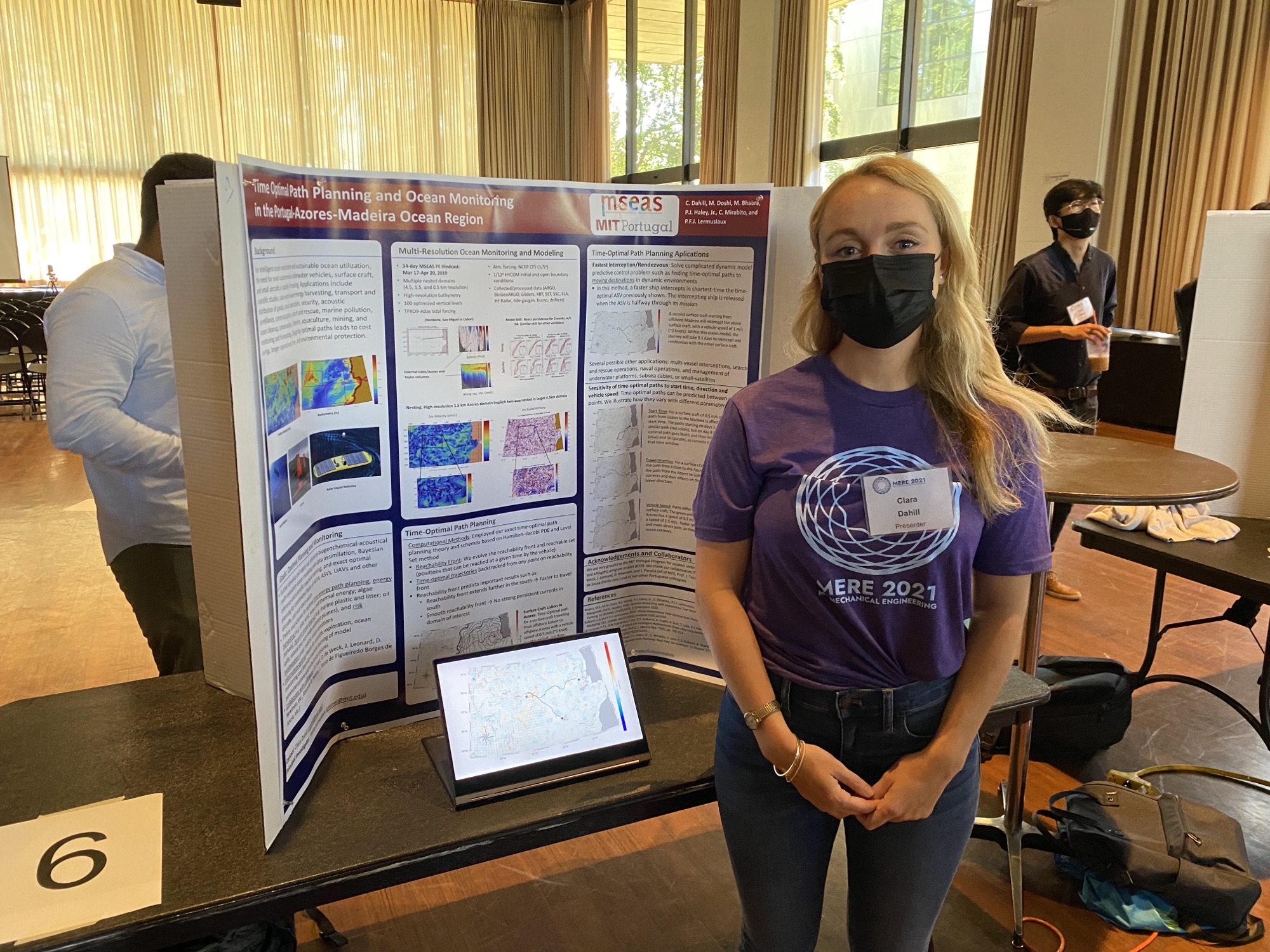
Clara and Manan Win Research Prizes at MERE 2021

Congratulations to Clara and Manan for their MERE 2021 performance! Clara presented her research on “Time Optimal Path Planning and Ocean Monitoring in the Portugal-Azores-Madeira Ocean Region,” and won the Best First-Time Presenter prize! Meanwhile, Manan presented his research on “Autonomous Path Planning to Optimally Harvest Dynamic Fields,” and received a Runner-up prize! Congratulations again to Clara and Manan!

Click the link for more information about the MERE 2021 Presentation Awards.

Game Theory for Unmanned Vehicles Path Planning in the Marine Domain: State of the Art and New Possibilities

Cococcioni, M., L. Fiaschi, and P.F.J. Lermusiaux, 2021. Game Theory for Unmanned Vehicles Path Planning in the Marine Domain: State of the Art and New Possibilities. Journal of Marine Science and Engineering 9(11), 1175. doi:10.3390/jmse9111175. Special Issue on Machine Learning and Remote Sensing in Ocean Science and Engineering.

Thanks to the advent of new technologies and higher real-time computational capabilities, the use of unmanned vehicles in the marine domain received a significant burst in the last decade. Ocean and seabed sampling, missions in dangerous areas, and civilians security are just a few of the large number of applications which currently benefit from unmanned vehicles. One of the most actively studied topic is their full autonomy, i.e., the design of marine vehicles capable of pursuing a task while reacting to the changes of the environment without the intervention of humans, not even remote. Environment dynamicity may consist in variations of currents, presence of unknown obstacles, and attacks from adversaries (e.g., pirates). To achieve autonomy in such highly dynamic uncertain conditions, many types of autonomous path planning problems need to be solved. There has thus been a commensurate number of approaches and methods to optimize such path planning. This work focuses on game theoretic ones and provides a wide overview of the current state of the art, along with future directions.

Adaptive Stochastic Reduced Order Modeling for Autonomous Ocean Platforms

Ryu, T., J.P. Heuss, P.J. Haley, Jr., C. Mirabito, E. Coelho, P. Hursky, M.C. Schönau, K. Heaney, and P.F.J. Lermusiaux, 2021. Adaptive Stochastic Reduced Order Modeling for Ocean Autonomous Platforms. In: OCEANS '21 IEEE/MTS San Diego, 20-23 September 2021, pp. 1-9. doi:10.23919/OCEANS44145.2021.9705790

Onboard probabilistic forecasting and data assimilation is challenging for unmanned autonomous platforms. Due to the operational constraints, efficient adaptive reduced order models (ROMs) are needed. To extend the duration for which Dynamic Mode Decomposition (DMD) predictions are accurate, we utilize and augment incremental methods that update the reduced order state but also adapt the DMD. Our adaptive ROM methods are dynamic and stochastic. They update the state, parameters, and basis functions, in response to the changing forecasts, possibly computed in remote centers, and to observations made by the autonomous platforms and by other assets. For the latter, to allow learning even when observations are sparse and multivariate, we employ Bayesian data assimilation. Specifically, we extend the Gaussian Mixture Model – Dynamically Orthogonal (GMM-DO) filter to stochastic DMD forecasts and Bayesian GMM updates of the DMD coefficients, state, and parameters, learning from the limited gappy observation data sets.

High-order Discontinuous Galerkin Methods for Nonhydrostatic Ocean Processes with a Free Surface

Foucart, C., C. Mirabito, P.J. Haley, Jr., and P.F.J. Lermusiaux, 2021. High-order Discontinuous Galerkin Methods for Nonhydrostatic Ocean Processes with a Free Surface. In: OCEANS '21 IEEE/MTS San Diego, 20-23 September 2021, pp. 1-9. doi:10.23919/OCEANS44145.2021.9705767

Accurate numerical simulation and modeling of ocean dynamics is playing an increasingly large role in scientific ocean applications. However, resolving these dynamics with traditional computational techniques can often be prohibitively expensive, necessitating the creation of next-generation high-order ocean models. In this work, we apply the local discontinuous Galerkin (LDG) and hybridizable discontinuous Galerkin (HDG) finite element methodology to discretize the ocean equations with a free-surface. We provide comparison of the strengths and weaknesses of the two formulations in terms of accuracy, efficiency, and scalability, and provide detailed discussion of numerical choices and their consequences as they relate to ocean modeling. We verify our methodology with numerical experiments and results from nonhydrostatic gravity wave theory.