headgraphic
loader graphic

Loading content ...

Northern Arabian Sea Circulation-Autonomous Research (NASCar): A Research Initiative Based on Autonomous Sensors

Centurioni, L.R., V. Hormann, L. D. Talley, I. Arzeno, L. Beal, M. Caruso, P. Conry, R. Echols, H. J. S. Fernando, S. N. Giddings, A. Gordon, H. Graber, R. Harcourt, S. R. Jayne, T. G. Jensen, C. M. Lee, P. F. J. Lermusiaux, P. L’Hegaret, A. J. Lucas, A. Mahadevan, J. L. McClean, G. Pawlak, L. Rainville, S. Riser, H. Seo, A. Y. Shcherbina, E. Skyllingstad, J. Sprintall, B. Subrahmanyam, E. Terrill, R. E. Todd, C. Trott, H. N. Ulloa, and H. Wang, 2017. Northern Arabian Sea Circulation-Autonomous Research (NASCar): A Research Initiative Based on Autonomous Sensors. Oceanography 30(2):74–87, https://doi.org/​10.5670/oceanog.2017.224.

The Arabian Sea circulation is forced by strong monsoonal winds and is characterized by vigorous seasonally reversing currents, extreme differences in sea surface salinity, localized substantial upwelling and widespread submesoscale thermohaline structures. Its complicated sea surface temperature patterns are important for the onset and evolution of the Asian Monsoon. Here we describe a program that aims to elucidate the role of upper ocean processes and atmospheric feedbacks in setting the sea surface temperature properties of the region. The wide range of spatial and temporal scales and the difficulty of accessing much of the region with ships due to piracy motivated a novel approach based on state-of-the-art autonomous ocean sensors and platforms. The extensive dataset that is being collected, combined with numerical models and remote sensing data, confirms the role of planetary waves in the reversal of the Somali Current system. These data also document the fast response of the upper equatorial ocean to the monsoon winds through changes in temperature and salinity and the connectivity of the surface currents across the northern Indian Ocean. New observations of thermohaline interleaving structures and mixing in setting the surface temperature properties of the northern Arabian Sea are also discussed.

Optimal Planning and Sampling Predictions for Autonomous and Lagrangian Platforms and Sensors in the Northern Arabian Sea

Lermusiaux, P.F.J., P.J. Haley Jr., S. Jana, A. Gupta, C.S. Kulkarni, C. Mirabito, W.H. Ali, D.N. Subramani, A. Dutt, J. Lin, A. Y. Shcherbina, C. M. Lee, and A. Gangopadhyay, 2017. Optimal Planning and Sampling Predictions for Autonomous and Lagrangian Platforms and Sensors in the Northern Arabian Sea. Oceanography 30(2):172–185, https://doi.org/10.5670/oceanog.2017.242.

Where, when, and what to sample, and how to optimally reach the sampling locations, are critical questions to be answered by Autonomous and Lagrangian Platforms and Sensors. For a reproducible scientific sampling approach, answers should be quantitative and provided using fundamental principles. Concepts and recent progress towards this principled approach are first overviewed, focusing on reachability, path planning, and adaptive sampling. Results of a real-time forecasting and planning experiment completed during February-April 2017 for the Northern Arabian Sea Circulation – Autonomous Research program are then presented. The predictive skill, layered fields, and uncertainty estimates obtained using our MIT MSEAS multi-resolution ensemble ocean modeling system are first studied. With such inputs, deterministic and probabilistic three-dimensional reachability forecasts issued daily for gliders and floats are then showcased and validated. Our Bayesian adaptive sampling framework is finally shown to forecast in real-time the observations that are most informative for estimating classic ocean fields but also secondary-variables such as Lagrangian Coherent Structures.

Chance Emerson

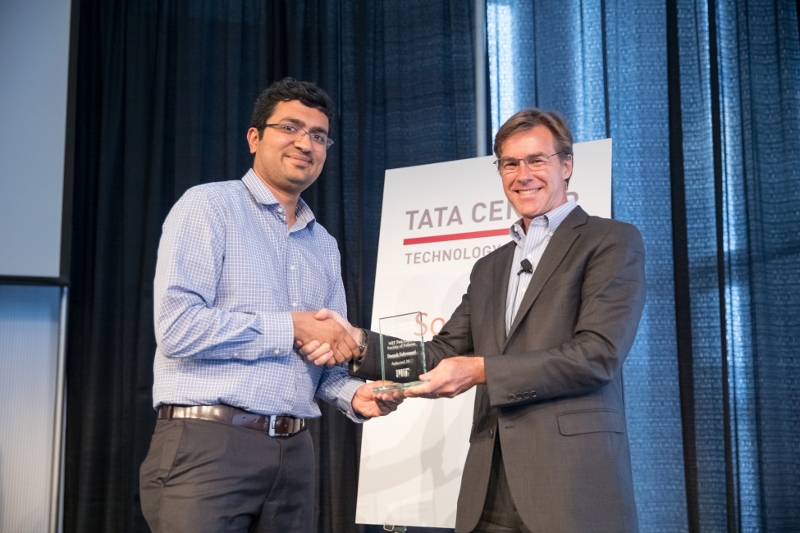
Deepak Inducted to Society of Tata Fellows; Wins Best Presentation Award at Pro-Seminar

Deepak Subramani was inducted to the MIT Tata Center Society of Fellows for completing 2 years of Tata Fellowship. He works on the project Coastal Forecasting for Sustainable Fisheries Management in India. He also won an award for the best presentation in the final fellowship review presentations at the Tata Pro-Seminar. Congratulations Deepak!

© Bryce Vickmark. All rights reserved. www.vickmark.com 617-448-6758

Chinmay Kulkarni Graduates with S.M. Degree

Chinmay Sameer Kulkarni completed all requirements and submitted a thesis to receive Master of Science Degree in Mechanical Engineering from School of Engineering at MIT. Congratulations to Chinmay and all the best for his Ph.D journey!