headgraphic
loader graphic

Loading content ...

Deepak Wins First Place in de Florez Competition 2017

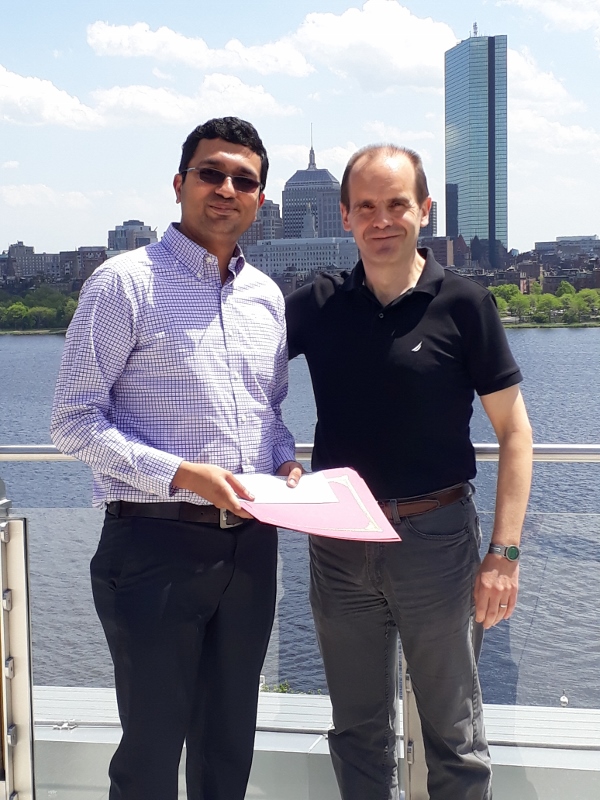
Deepak Subramani, a Ph.D candidate in the MSEAS group has won the first place in the de Florez Competition 2017. This year’s competition saw 30 entries, from among which Deepak was placed first under the Graduate Science category.

Deepak Wins Wunsch Award for Outstanding Research

Deepak Subramani, Ph.D candidate in MSEAS group has been awarded the Wunsch Award for Outstanding Research 2017. He was presented with the award at the Mechanical Engineering Student Awards Lunch on 5/19/2017.

Jing wins travel award to attend UQ workshop at UT Austin

Jing Lin, a fifth year graduate student, has been selected to receive a travel award to attend the Workshop on Uncertainty Quantification and Data-Driven Modeling, to be held from March 23 to 24, 2017, at the University of Texas at Austin, Texas, USA. Congratulations Jing!

Autonomy for Surface Ship Interception

Mirabito, C., D.N. Subramani, T. Lolla, P.J. Haley, Jr., A. Jain, P.F.J. Lermusiaux, C. Li, D.K.P. Yue, Y. Liu, F.S. Hover, N. Pulsone, J. Edwards, K.E. Railey, and G. Shaw, 2017. Autonomy for Surface Ship Interception. In: Oceans '17 MTS/IEEE Aberdeen, 1-10, 19-22 June 2017, DOI: 10.1109/OCEANSE.2017.8084817

In recent years, the use of autonomous undersea vehicles (AUVs) for highly time-critical at-sea operations involving surface ships has received increased attention, magnifying the importance of optimal interception. Finding the optimal route to a moving target is a challenging procedure. In this work, we describe and apply our exact time-optimal path planning methodology and the corresponding software to such ship interception problems. A series of numerical ship interception experiments is completed in the southern littoral of Massachusetts, namely in Buzzards Bay and Vineyard Sound around the Elizabeth Islands and Martha’s Vineyard. Ocean currents are estimated from a regional ocean modeling system. We show that complex coastal geometry, ship proximity, and tidal current phases all play key roles influencing the time-optimal vehicle behavior. Favorable or adverse currents can shift the optimal route from one island passage to another, and can even cause the AUV to remain nearly stationary until a favorable current develops. We also integrate the Kelvin wedge wake model into our path planning software, and show that considering wake effects significantly complicates the shape of the time-optimal paths, requiring AUVs to execute sequences of abrupt turns and tacking maneuvers, even in highly idealized scenarios. Such behavior is reminiscent of ocean animals swimming in wakes. In all cases, it is shown that our level set partial differential equations successfully guide the time-optimal vehicles through regions with the most favorable currents, avoiding regions with adverse effects, and accounting for the ship wakes when present.

Data-driven Learning and Modeling of AUV Operational Characteristics for Optimal Path Planning

Edwards, J., J. Smith, A. Girard, D. Wickman, P.F.J. Lermusiaux, D.N. Subramani, P.J. Haley, Jr., C. Mirabito, C.S. Kulkarni, and, S. Jana, 2017. Data-driven Learning and Modeling of AUV Operational Characteristics for Optimal Path Planning. In: Oceans '17 MTS/IEEE Aberdeen, 1-5, 19-22 June 2017, DOI: 10.1109/OCEANSE.2017.8084779

Autonomous underwater vehicles (AUVs) are used to execute an increasingly challenging set of missions in commercial, environmental and defense industries. The resources available to the AUV in service of these missions are typically a limited power supply and onboard sensing of its local environment. Optimal path planning is needed to maximize the chances that these AUVs will successfully complete long endurance missions within their power budget. A time-optimal path planner has been recently developed to minimize AUV mission time required to traverse a dynamic ocean environment at a specified speed through the water. For many missions, time minimization is appropriate because the AUVs operate at a fixed propeller speed. However, the ultimate limiting constraint on AUV operations is often the onboard power supply, rather than mission time. While an empirical or theoretical relationship between mission time and power could be applied to estimate power usage in the path planner, the real power usage and availability on an AUV varies mission-to-mission, as a result of multiple factors, including vehicle buoyancy, battery charge cycle, fin configuration, and water type or quality. In this work, we use data collected from two mid-size AUVs operating in various conditions to learn the mission-to-mission variability in the power budget so that it could be incorporated into the mission planner.