headgraphic
loader graphic

Loading content ...

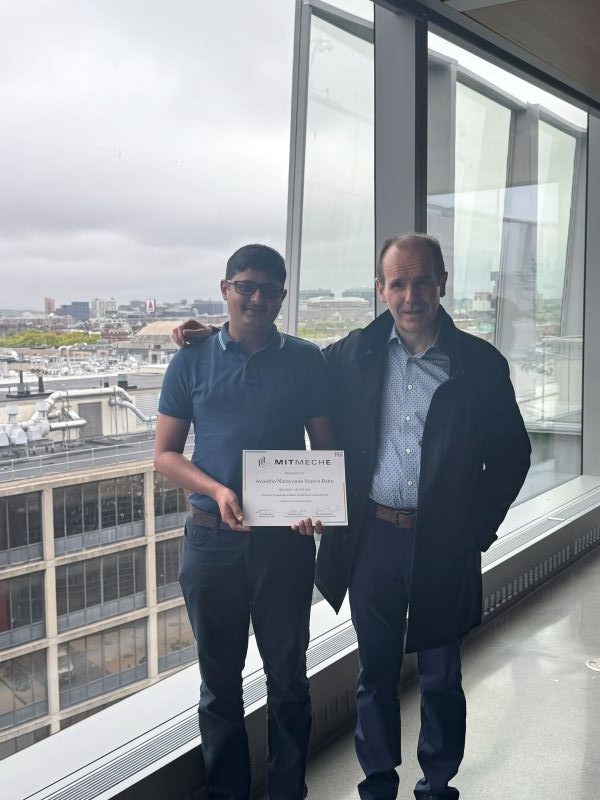
Anantha Awarded Wunsch Foundation Silent Hoist and Crane Award

Graduate student Anantha Narayanan Suresh Babu has been awarded a 2026 Wunsch Foundation Silent Hoist and Crane Award for Outstanding Graduate Research and Education by the Department of Mechanical Engineering. Congratulations Anantha!

Assessing Existing Correlations and Proposing a New Heat Transfer Correlation for High-Pr Fluid Pebble Bed Reactors

Scott, E., 2026. Assessing Existing Correlations and Proposing a New Heat Transfer Correlation for High-Pr Fluid Pebble Bed Reactors. B.S. Thesis, Massachusetts Institute of Technology, Dept. of Mechanical Engineering, May 2026.

Fluoride-salt-cooled high-temperature reactors (FHRs) are a Gen IV nuclear reactor design that combine the meltdown resistance and online refueling capabilities of pebble-bed cores with the excellent heat transfer properties and atmospheric pressure operation of molten salt coolants. Accurate prediction of the convective heat transfer (directly determined by the Nusselt number) between fuel pebbles and the surrounding coolant is critical to both the safety and efficiency of these reactors. Many classical packed-bed Nusselt correlations widely used in reactor analysis codes (Wakao, KTA, Gunn, Gnielinski, Achenbach, Whitaker, and Petrovic) were developed almost entirely with gas-cooled data (Pr ≈ 0.7), while FHR conditions involve molten salts with Pr ≈ 11–25. Use of these correlations in FHR contexts extrapolates them well beyond their original calibration ranges, introducing uncertainty into reactor design tools at a critical stage of FHR development.

This thesis addresses that gap by analyzing a compiled dataset of high-Pr pebble-bed heat transfer results drawn from three experimental studies (Meng 2012, Liu 2018, Wang 2022) and four CFD studies (Dave 2020, Yuan 2023, Wang 2024, Liu 2025). The compiled dataset spans Re ≈ 50–6600, Pr ≈ 6–24, and porosities ε ≈ 0.26–0.57. Seven classical correlations and four modern high-Pr correlations are benchmarked against each dataset using mean absolute relative error, with results grouped by porosity to expose porosity-dependent biases. The analysis reveals that correlations with explicit porosity dependence (KTA, Gnielinski, Gunn) systematically over-predict at low porosity due to extrapolation of their ε-dependent terms, while Achenbach consistently under-predicts due to its absence of a Pr term. Wakao demonstrates the most consistent behavior across porosity ranges.

A supplementary OpenFOAM single-sphere study evaluates the commonly cited thermal-boundary-layer-thinning argument for high-Pr discrepancies and finds that the argument does not directly extend to laminar single-sphere geometries. This suggests that packed-bed-specific transport mechanisms and configurations, rather than pure boundary-layer scaling, may be driving the observed differences in the packed-bed correlations.

A new correlation of the form Nu = 4.08Re0.39Pr0.4 is developed via ordinary least-squares regression in log-space across a selected subset of the compiled dataset (the high porosity cases were determined to be outliers and excluded from the fit). This correlation achieves the lowest mean error in the low and mid-porosity bins, which is the regime most relevant to FHR operation (ε ≈ 0.4). The exponents are consistent with both the transition-regime Re scaling expected in the FHR-relevant Re range of 100–1000 and the high-Pr empirical scaling observed across independent fits in the literature. The proposed correlation may provide an improved tool for FHR thermal-hydraulic analysis within its calibration envelope and may serve as a benchmark for future correlation development as additional high-Pr pebble-bed data becomes available.

Optimal Dynamic Formation and Coverage for Autonomous Platforms in Multiscale Ocean Flows

Liu, P.C.C. and P.F.J. Lermusiaux, 2026. Optimal Dynamic Formation and Coverage for Autonomous Platforms in Multiscale Ocean Flows. In: OCEANS '26 IEEE/MTS Monterey, 21–24 September 2026, sub-judice.

Autonomous marine platforms are becoming essential tools for ocean science and operations because they can collect observations over large areas and long durations while reducing the cost, risk, and logistical burden of ship-based campaigns. They are now used for environmental monitoring, adaptive sampling, ocean forecasting, upper-ocean and air–sea observations, infrastructure inspection, and other persistent observing tasks.

However, there is increasing value in operating these vehicles as coordinated teams rather than as isolated platforms. Multi-vehicle systems can sample larger regions, observe evolving phenomena at multiple locations simultaneously, and adapt more effectively to dynamic environmental features. To realize these advantages, vehicles should remain sufficiently spread over the region of interest so that different parts of the environment are sampled and measurements do not cluster inefficiently in only a small portion of the domain. It can also be beneficial for the team to preserve an organized group structure, since maintaining prescribed relative positions, shapes, or coverage properties allows the vehicles to function as a coordinated sensing array for feature tracking and cooperative sampling.

In this work, we study the coordinated control of multiple autonomous marine vehicles in dynamic flow environments using the MIT-MSEAS general partial differential equations for reachability and optimal planning.

A Hybridizable Discontinuous Galerkin Solver for Quasi-Geostrophic Flows in Complex Domains

Saravanakumar, A.K. and P.F.J. Lermusiaux, 2026. A Hybridizable Discontinuous Galerkin Solver for Quasi-Geostrophic Flows in Complex Domains. In: OCEANS '26 IEEE/MTS Monterey, 21–24 September 2026, sub-judice.

Numerical modeling of ocean dynamics is critical for studying and predicting a wide range of geophysical phenomena, including mesoscale turbulence and coastal circulation. However, resolving the wide range of spatial scales present in such flows, particularly in domains with complex coastlines and bathymetry, remains computationally challenging. Low order finite difference and finite volume schemes often require fine spatial resolution to capture turbulent structures, leading to intractable computational costs. Pseudo-spectral solvers provide an attractive alternative due to their exponential accuracy and computational efficiency for smooth solutions, but they are generally restricted to simple periodic geometries or require special boundary schemes. High-order discontinuous Galerkin finite element methods offer a suitable compromise by combining geometric flexibility with high order accuracy, enabling computationally tractable simulations of turbulent flows in complex domains.

In this work, we implement a high-order hybridizable discontinuous Galerkin method-based (HDG) finite element solver for the two-dimensional quasi-geostrophic (QG) ocean equations.

Sparse and Deep Gaussian Process Closure Modeling for Non-Stationary Two-Dimensional β-Plane Vorticity Flows Past Idealized Obstacles

Mouzahir, S. and P.F.J. Lermusiaux, 2026. Sparse and Deep Gaussian Process Closure Modeling for Non-Stationary Two-Dimensional β-Plane Vorticity Flows Past Idealized Obstacles. In: OCEANS '26 IEEE/MTS Monterey, 21–24 September 2026, sub-judice.

High-resolution simulations that fully resolve all spatiotemporal scales of geophysical and turbulent flows remain a challenge in large ocean domains. Large-eddy simulations (LES) make these computations tractable by filtering out subgrid-scale (SGS) features, but require accurate closures to remain stable and faithful; without them, solutions can drift, lose energy at the wrong rate, or develop spurious coastal artifacts. Classical analytical closures based on the eddy-viscosity hypothesis, such as the Smagorinsky and Leith models and their dynamic variants, were developed primarily for three-dimensional homogeneous turbulence. A recent benchmarking study has shown that they logically only weakly capture the SGS forcing in two-dimensional vorticity flows in the presence of coastal boundaries and interior landforms, motivating the development of data-driven closures. Among such approaches, neural-network closures have shown promise but typically return only a deterministic point estimate of the SGS term, while the mapping from resolved to unresolved scales is fundamentally non-invertible and the closure is therefore intrinsically stochastic. This non-uniqueness becomes especially pronounced in nonstationary flows, where the wake statistics themselves drift in time and a single deterministic correction can likely not represent the spread of admissible SGS responses.

In this work, we develop and evaluate sparse and deep Gaussian process (GP) closures for under-resolved, non-stationary two-dimensional classical and β-plane vorticity flows past idealized obstacles, where non-stationarity is driven by a time modulated inflow velocity U(t) that produces a continuously evolving wake, with shedding frequency, wake width, and subgrid-scale statistics all drifting along the trajectory.