headgraphic
loader graphic

Loading content ...

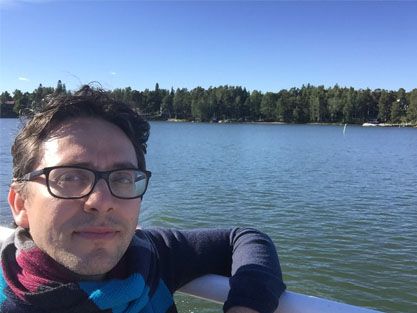
Francesco Trotta

Francesco is a junior researcher at the Department of Physics and Astronomy of the University of Bologna, Italy. He joins MSEAS for Summer/Fall 2019 as an MIT Visiting Scholar. One of his main goals while at MSEAS is to complete joint research on multiscale multi-dynamics relocatable ocean modeling for forecasting, including deterministic and stochastic predictions.

Francesco’s research interests span the fields of high-resolution ocean modelling, submesoscale processes in the ocean, and extreme value analysis. He is part of a research group which developed the relocatable ocean platform SURF (Structured and Unstructured grid Relocatable ocean platform for Forecasting), based on the NEMO code.

Fish Modeling and Bayesian Learning for the Lakshadweep Islands

Gupta, A., P.J. Haley, D.N. Subramani, and P.F.J. Lermusiaux, 2019. Fish Modeling and Bayesian Learning for the Lakshadweep Islands. In: OCEANS '19 MTS/IEEE Seattle, 27-31 October 2019, doi: 10.23919/OCEANS40490.2019.8962892

In fish modeling, a significant amount of uncertainty exists in the parameter values, parameterizations, functional form of model equations, and even the state variables themselves. This is due to the complexity and lack of understanding of the processes involved, as well as the measurement sparsity. These challenges motivate the present proof-of-concept study to simultaneously learn and estimate the state variables, parameters, and model equations from sparse observations. We employ a novel dynamics-based Bayesian learning framework for high-dimensional, coupled fish-biogeochemical-physical partial-differential equations (PDEs) models, allowing the simultaneous inference of the augmented state variables and parameters. After reviewing the status of ecosystem modeling in the coastal oceans, we first complete a series of PDE-based learning experiments that showcase capabilities for fish-biogeochemical-physical model equations and parameters, using nonhydrostatic Boussinesq flows past a seamount. We then showcase realistic ocean primitive-equation simulations and analyses, using fish catch data  for the Lakshadweep islands in India. These modeling and learning efforts could improve fisheries management from a standpoint of sustainability and efficiency.

Plastic Pollution in the Coastal Oceans: Characterization and Modeling

Lermusiaux, P.F.J., M. Doshi, C.S. Kulkarni, A. Gupta, P.J. Haley, Jr., C. Mirabito, F. Trotta, S.J. Levang, G.R. Flierl, J. Marshall, T. Peacock, and C. Noble, 2019. Plastic Pollution in the Coastal Oceans: Characterization and Modeling. In: OCEANS '19 MTS/IEEE Seattle, 27-31 October 2019, doi: 10.23919/OCEANS40490.2019.8962786

To cleanup marine plastics, accurate modeling is needed. We outline and illustrate a new partial-differential-equation methodology for characterizing and modeling plastic transports in time and space (4D), showcasing results for Massachusetts Bay. We couple our primitive equation model for ocean dynamics with our composition based advection for Lagrangian transport. We show that the ocean physics predictions have skill by comparison with synoptic data. We predict the fate of plastics originating from four sources: rivers, beach and nearshore, local Bay, and remote offshore. We analyze the transport patterns and the regions where plastics accumulate, comparing results with and without plastic settling. Simulations agree with existing debris and plastics data. They also show new results: (i) Currents set-up by wind events strongly affect floating plastics. Winds can for example prevent Merrimack outflows reaching the Bay; (ii) There is significant chaotic stirring between nearshore and offshore floating plastics as explained by ridges of Lagrangian Coherent Structures (LCSs); (iii) With 4D plastic motions and settling, plastics from the Merrimack and nearshore regions can settle to the seabed before offshore advection; (iv) Internal waves and tides can bring plastics downward and out of main currents, leading to settling to the deep bottom. (v) Attractive LCSs ridges are frequent in the northern Cape Cod Bay, west of the South Shore, and southern Stellwagen Bank. They lead to plastic accumulation and sinking along thin subduction zones.

Flowmaps and Coherent Sets for Characterizing Residence Times and Connectivity in Lagoons and Coral Reefs: The Case of the Red Sea

Doshi, M.M., C.S. Kulkarni, W.H. Ali, A. Gupta, P.F.J. Lermusiaux, P. Zhan, I. Hoteit, and O.M. Knio, 2019. Flowmaps and Coherent Sets for Characterizing Residence Times and Connectivity in Lagoons and Coral Reefs: The Case of the Red Sea. In: OCEANS '19 MTS/IEEE Seattle, 27-31 October 2019, doi:10.23919/OCEANS40490.2019.8962643

To understand the dynamics and health of marine ecosystems such as lagoons and coral reefs as well as to understand the impact of human activities on these systems, it is imperative to predict the residence times of water masses and connectivity between ocean domains. In the present work, we consider the pristine lagoons and coral reefs of the Red Sea as an example of such sensitive ecosystems, with a large number of marine species, many of which are unique to the region. To study the residence times and connectivity patterns, we make use of recent advances in dynamic three-dimensional Lagrangian analyses using partial differential equations. Specifically, we extend and apply our novel efficient flow map composition scheme to predict the time needed for any particular water parcel to leave the domain of interest (i.e., a lagoon) as well as the time for any particular water parcel to enter that domain. These spatiotemporal residence time fields along with four-dimensional Lagrangian metrics such as finite time Lyapunov exponent (FTLE) fields provide a quantitative description of the Lagrangian pathways and connectivity patterns of lagoons in the Red Sea.

Stochastic Oceanographic-Acoustic Prediction and Bayesian Inversion for Wide Area Ocean Floor Mapping

Ali, W.H., M.S. Bhabra, P.F.J. Lermusiaux, A. March, J.R. Edwards, K. Rimpau, and P. Ryu, 2019. Stochastic Oceanographic-Acoustic Prediction and Bayesian Inversion for Wide Area Ocean Floor Mapping. In: OCEANS '19 MTS/IEEE Seattle, 27-31 October 2019, doi:10.23919/OCEANS40490.2019.8962870

Covering the vast majority of our planet, the ocean is still largely unmapped and unexplored. Various imaging techniques researched and developed over the past decades, ranging from echo-sounders on ships to LIDAR systems in the air, have only systematically mapped a small fraction of the seafloor at medium resolution. This, in turn, has spurred recent ambitious efforts to map the remaining ocean at high resolution. New approaches are needed since existing systems are neither cost nor time effective. One such approach consists of a sparse aperture mapping technique using autonomous surface vehicles to allow for efficient imaging of wide areas of the ocean floor. Central to the operation of this approach is the need for robust, accurate, and efficient inference methods that effectively provide reliable estimates of the seafloor profile from the measured data. In this work, we utilize such a stochastic prediction and Bayesian inversion and demonstrate results on benchmark problems. We first outline efficient schemes for deterministic and stochastic acoustic modeling using the parabolic wave equation and the optimally-reduced Dynamically Orthogonal equations and showcase results on stochastic test cases. We then present our Bayesian inversion schemes and its results for rigorous nonlinear assimilation and joint bathymetry-ocean physics-acoustics inversion.