headgraphic
loader graphic

Loading content ...

Bayesian Inference of High-Dimensional Dynamical Models: The Survival of the Fittest

Speaker: Pierre F.J. Lermusiaux
[Announcement (PDF)]

Speaker Affiliation: Associate Professor,
Department of Mechanical Engineering
Ocean Science and Engineering
Massachusetts Institute of Technology

Date: Thursday, November 3, 2016 at 12 p.m in 37-212
CCE Seminar

We develop and illustrate a dynamics-based Bayesian inference methodology that assimilates sparse observations for the joint inference of the state, parameters, boundary conditions, and initial conditions of dynamical models, but also of the parameterizations, geometry, and model equations themselves. The joint Bayesian inference combines stochastic Dynamically Orthogonal (DO) partial differential equations for reduced-dimension probabilistic prediction with Gaussian Mixture Models for nonlinear filtering and smoothing. The Bayesian model inference is completed by parallelized and analytical computation of marginal likelihoods for multiple candidate models. The classes of models considered correspond to competing scientific hypotheses and differ in complexity and in the representation of specific processes. Within each model class, model equations have unknown parameters and uncertain parameterizations, all of which are estimated. For each model class, the result is a Bayesian update of the joint distribution of the state, parameters, and parameterizations. The combined scientific result is a rigorous Bayesian inference of the marginal distribution of dynamical model equations. Examples are provided for time-dependent fluid and ocean flows. They include the inference of multiscale bottom gravity current dynamics, motivated in part by classic dense water overflows and their relevance to climate monitoring. The Bayesian inference of biogeochemical reaction equations is then presented, illustrating how PDE-based machine learning could rigorously guide the selection and discovery of complex ecosystem or other reaction models. This is joint work with our MSEAS group at MIT.


Marine Science of Autonomy: From Theory to Practice

Speaker: Pierre F.J. Lermusiaux

Speaker Affiliation: Associate Professor,
Department of Mechanical Engineering
Ocean Science and Engineering
Massachusetts Institute of Technology

Date: Friday October 28, 2016 at 4 p.m in 3-270

The science of autonomy is the systematic development of funda­mental knowledge about autonomous decision making and task completing in the form of testable autonomous methods, models, and systems. Marine autonomy applications are rapidly growing, both in numbers and in complexity. For systematic advances, we integrate varied disciplines and provide fundamental results in minimum-time path planning, energy-optimal path planning, and optimal adaptive sampling based on mutual information fields, all in complex dynamic flows. The aim is to set a theoretical basis for a large number of vehicles forming heterogeneous and collabora­tive underwater swarms that are smart, i.e. knowledgeable about the predicted environment and their uncertainties, and about the predicted effects of autonomous sensing on future operations. Results are thus extended to coordinated groups of vehicles that maintain swarm formations and avoid dynamic obstacles, and to three-dimensional paths, anisotropic motion constraints, onboard adaptive routing, and path planning under uncertainty. Examples are provided for varied nonlinear fluid and ocean conditions. We also highlight some of our recent related results, including: Bayes­ian nonlinear data assimilation and inference of model equations; multiresolution high-order modeling; multiscale ocean dynamics; and, stochastic Lagrangian Coherent Structures.

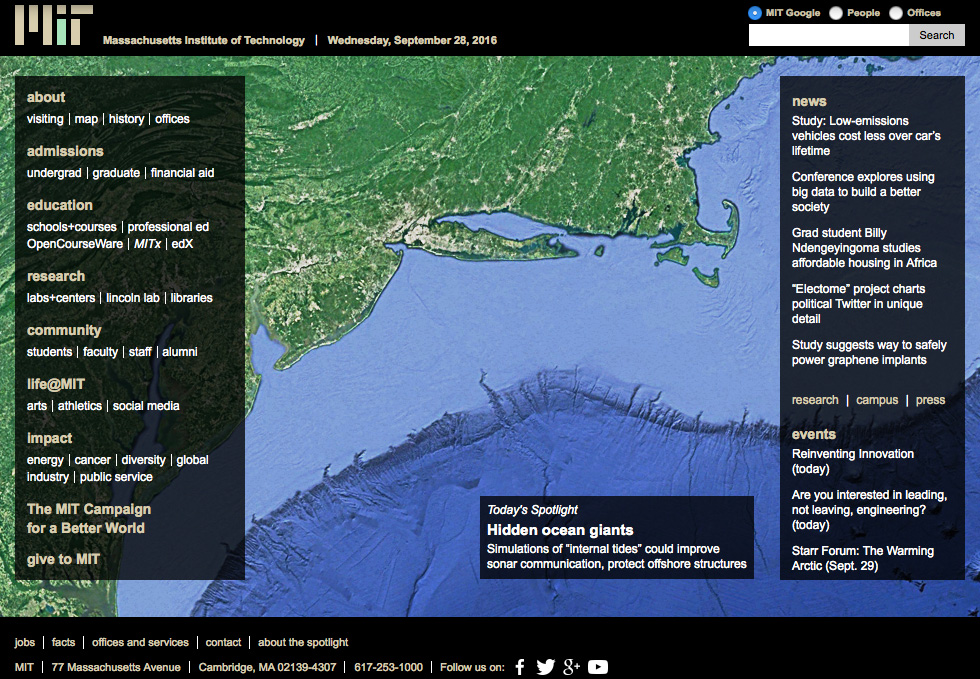
MSEAS research featured on MIT front page

Recent results from the MSEAS group on the multiscale interactions of internal tides in the Middle Atlantic Bight and Shelfbreak front regions were featured on MIT front page on Sept 28, 2016. The article is entitled “Researchers find explanation for interacting giant, hidden ocean waves” and can be accessed here. The relevant papers “Internal-tide Interactions with the Gulf Stream and Middle Atlantic Bight Shelfbreak Front” published in JGR Oceans can be accessed here and the paper “A Coupled-mode Shallow Water model for tidal analysis: Internal-tide reflection and refraction by the Gulf Stream” published in JPO can be accessed here.

Deepak and Florian win awards at the MechE Research Exhibition 2016

Congratulations to Deepak Subramani, PhD Student, for winning the Esteemed Presenter award in the Best Live Demo Category and Florian Feppon, MS Student, for winning an Honorable Mention award at the Mechanical Engineering Research Exhibition (MERE) 2016 (Link). The exhibition had more than 80 presenters and 450 attendees.

Wael H. Ali

Wael is a third-year graduate student in the MechE-CSE PhD program. His research interests span the fields of computational engineering, uncertainty quantification and data assimilation. His current work focuses on the efficient modeling of ocean acoustic waves propagation and signal tomography in the presence of environmental uncertainties, with the goal of using these tools to develop an underwater GPS system. Before joining MIT, Wael spent four fruitful years at the American University of Beirut (AUB), where he had the opportunity to refine his interests in the history and archaeology of Lebanon and the Middle East. He is currently working on: His publications so far include: